
written by: News Desk
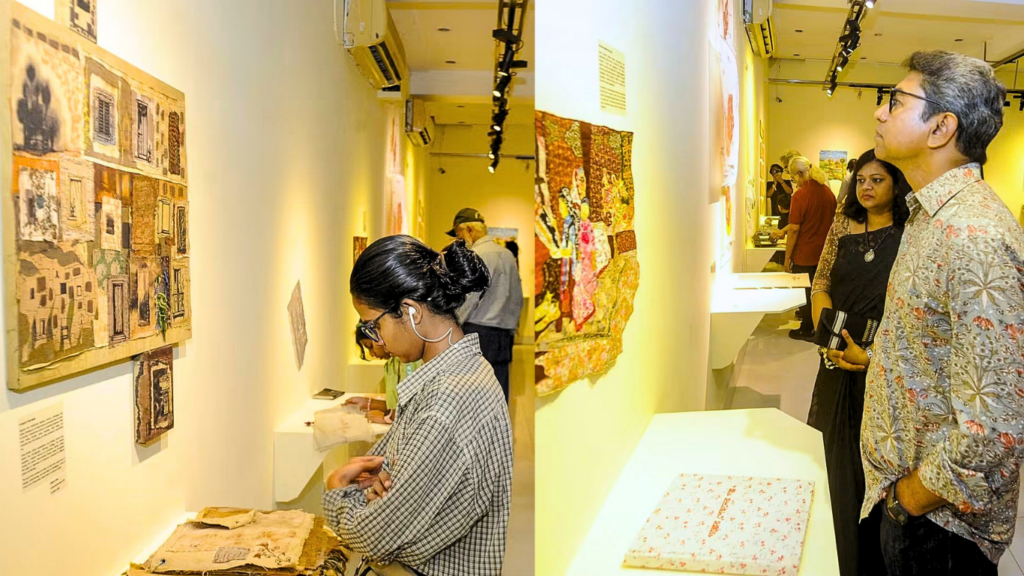
At La Galerie, Alliance Française de Dhaka, a group of artists turned to books, images, textiles and found materials to explore the stories that memory preserves—and the experiences that often remain unspoken.
Some stories are difficult to tell in words.
They survive instead in fragments—a remembered image, a familiar object, a piece of fabric, a handwritten note, a gesture or a fleeting sensation. Untold Story, a group exhibition curated by artist Fareha Zeba, explored precisely these elusive spaces between memory and expression.
Held at La Galerie, Alliance Française de Dhaka, from 1 to 9 September 2026, the exhibition brought together artist books and contemporary artworks that examined memory, identity, heritage, loss, longing and lived experience.
Rather than presenting a single, unified narrative, Untold Story embraced plurality. The works revealed how personal histories can be fragmented, reconstructed and reinterpreted—and how what remains unsaid can sometimes be as powerful as what is openly expressed.
At the centre of the exhibition was the artist’s book.
Here, the book was not treated simply as something to be read. It became an intimate artistic space—a place where memories could be collected, personal histories revisited and experiences given a material form.
This approach allowed the artists to move beyond conventional storytelling. Pages could become surfaces for drawings, objects could become fragments of recollection, while stitching, textiles and collage could function almost like visual traces of a personal archive.
The result was an exhibition in which the act of remembering became a creative process in itself.
The participating artists approached the theme from distinctly different perspectives.
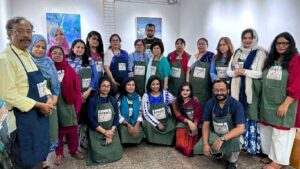
Esha Ahmed, Fouzia Mahin Choudhury, Kazmin Samia, Shulekha Chaudhury, Sumana Akter and Surovi Akter, together with curator and artist Fareha Zeba, developed their engagement with the artist’s book over the course of a year.
Their works were joined by guest artists Alia Kamal, Arpita Singha, Mahmuda Siddika, Rafia Mahjabeen, Rituparna Saha and Venessa Kaiser, who explored the theme through their own artistic practices.
Across the exhibition, painting, drawing, collage, stitching, embroidery, textiles, collected objects and experimental book forms created a diverse visual vocabulary. There was no attempt to force these works into a single aesthetic language. Instead, their differences became part of the exhibition’s strength.
Each work carried its own rhythm of remembering.
One of the most compelling aspects of Untold Story was its attention to the space between revelation and concealment. Memory is rarely complete. It shifts with time, loses details and sometimes changes shape. Personal histories can also contain gaps—things remembered vividly alongside things deliberately forgotten or left unspoken.
The exhibition responded to this complexity through fragmentation.
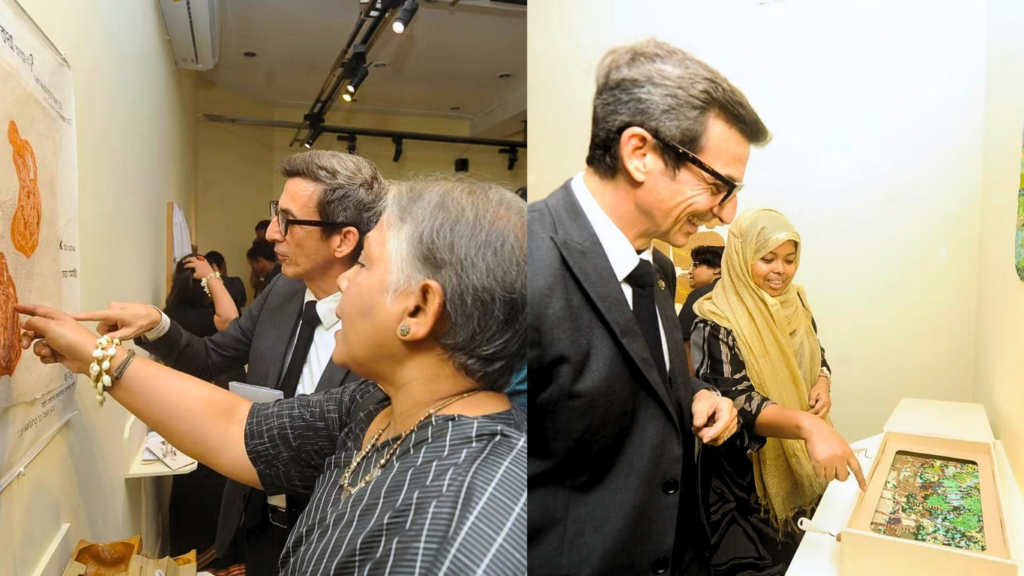
Rather than offering straightforward narratives, the works suggested stories through traces and associations. A material, an image or an object could evoke an entire history without explaining it completely.
In that sense, the exhibition did not simply ask artists to tell their stories. It invited them to consider how stories are remembered, recorded and transformed. Although many of the works emerged from deeply personal experiences, Untold Story did not remain confined to the private sphere.
The exhibition created a space where individual memories could resonate with broader human experiences.
Loss, belonging, identity, heritage, longing and the desire to preserve the past are not exclusive to any one person. What begins as an intimate memory can acquire a collective meaning when encountered by another viewer. This movement—from the personal to the shared—gave the exhibition much of its emotional depth.
The artist’s books formed the conceptual heart of Untold Story, but the exhibition extended well beyond the pages themselves. Through painting, drawing, textiles, collage, stitching and found materials, the artists translated personal narratives into different physical and visual forms.
The gallery therefore became something of an expanded book: its rooms functioning like pages, while individual artworks acted as fragments of stories waiting to be connected. The experience was less about arriving at a definitive interpretation and more about allowing associations to emerge.
Untold Story ultimately resisted the idea that every story needs to be complete. Some narratives remain fragmented. Some memories are uncertain. Some experiences cannot easily be translated into language. And some stories may be deliberately kept private. By embracing these gaps, the exhibition created room for ambiguity.
Its significance lay not only in the stories the artists chose to reveal, but also in the silences surrounding them.
In a culture increasingly dominated by rapid images and immediate communication, Untold Story offered a slower form of looking—one that encouraged audiences to pause, remember and consider the layers hidden beneath familiar experiences.
The exhibition may have closed on 9 September, but the questions it raised remain open.
What do we choose to remember? What do we leave behind? And when words fail, what other forms can carry a story?
Untold Story suggested that sometimes a memory does not need to be fully explained to be understood. It only needs a form in which it can continue to live.