
written by: News Desk
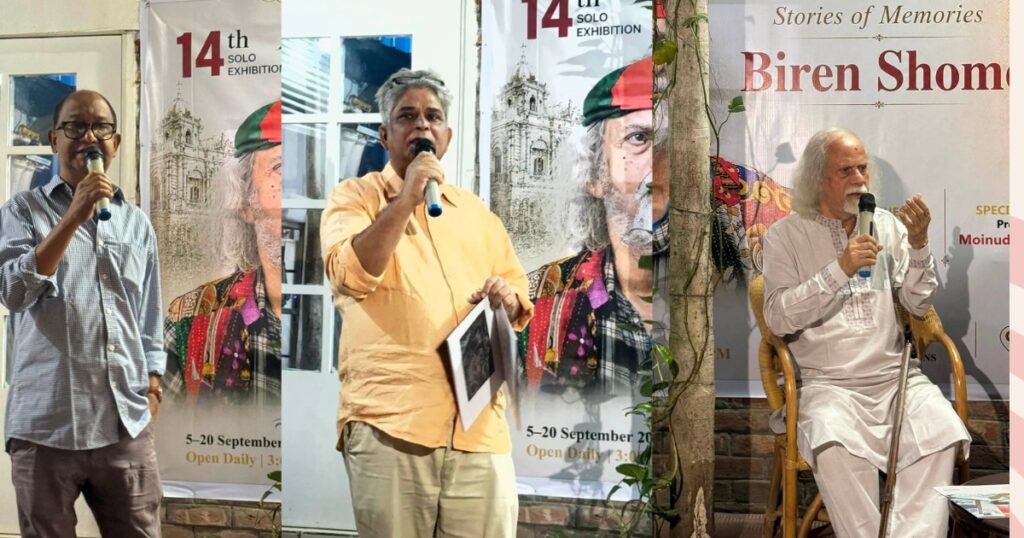
Memory is rarely linear. It carries within it fragments of images, people, nature, history, personal experience, and traces of what has been forgotten. In his latest solo exhibition, veteran artist Biren Shome revisits this complex terrain of memory through an ornamental, oriental-inflected visual language. Titled Stories of Memories, the exhibition brings together personal recollections and collective histories, creating a multilayered visual landscape at Gallery The Illusions in Lalmatia, Dhaka.
Organised by Gallery Shilpangan and inaugurated on 5 September, the 15-day exhibition features 53 works, including prints, drawings, and paintings. Birds, flowers, rivers, villages, architectural fragments, and human faces recur throughout the exhibition. At times semi-abstract and at others fully abstract, these motifs emerge through layers of lines, colours, and forms, evoking memories that are at once intimate and elusive.
A defining feature of Biren Shome’s practice is his deep engagement with line. In his recent works, the line appears increasingly spontaneous, liberated, and exploratory. Particularly striking are his new pattern drawings on black paper. Using gold and silver ballpoint pens, pastels, and coloured pencils, Shome creates intricate networks of lines across dark surfaces. Decorative in appearance yet contemplative in character, these works reveal an artist who, even in his eighties, continues to explore new possibilities of line, rhythm, and visual structure.
Although the subjects of these works are diverse, they are connected by an underlying meditation on the relationship between human beings, nature, and time. Bauls, the Liberation War, birds, and elements of the natural world do not merely function as subjects in Shome’s paintings; they become carriers of memory and metaphors of existence. Experiences such as decay, transformation, and mortality are rarely stated directly. Instead, they surface through suggestion, symbolism, line, and visual rhythm.
Organic elements—flowers, leaves, birds, and trees—hold a particular significance in Shome’s oriental-inspired works. For the artist, these are more than representations of nature; they serve as vehicles for memory, emotion, and the inner psyche. His treatment of the bird also resonates with a longstanding strand of Bengali folk imagination, in which the bird transcends its physical identity and assumes a spiritual or metaphorical dimension. The idea of the Achin Pakhi, the elusive bird of Baul philosophy, seems to echo through his imagery. In many of his works, birds appear alongside women, creating an intimate and symbolic relationship between the human and the other-than-human.
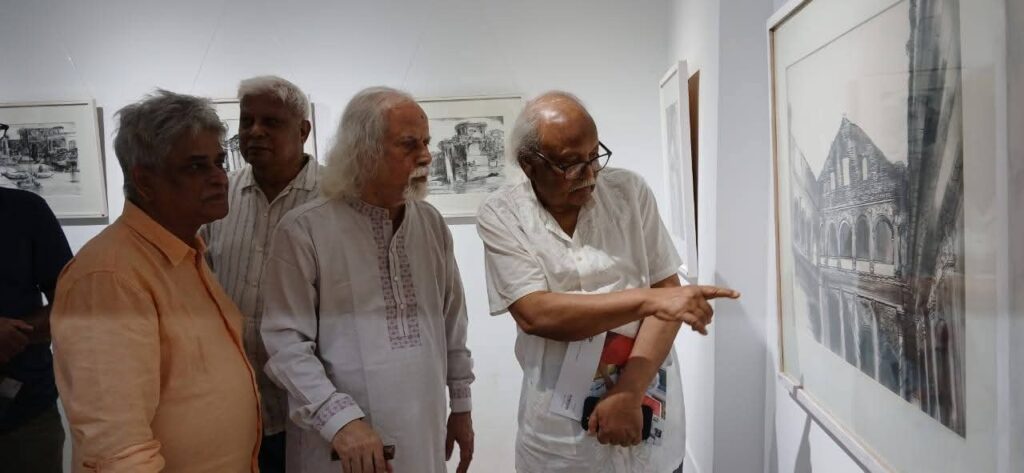
Memory and the passage of time become equally significant in Shome’s architectural series on Panam City and Old Dhaka. Through delicate and intricate line drawings, he portrays historic structures not simply as architectural remnants but as witnesses to the erosion of time and the traces of human absence. Watercolour washes layered over finely drawn lines give these works a sense of fragility, as though the buildings themselves are gradually dissolving into memory. Windows, walls, courtyards, and ornamental details become more than historical records; they emerge as repositories of both personal and collective remembrance.
Another significant work in the exhibition is Red Fantasy, an abstract acrylic-on-canvas painting that reveals a different dimension of Shome’s artistic inquiry. Moving away from recognisable forms, the work explores colour, movement, and fluidity in an attempt to develop a more open and intuitive pictorial language. Within the broader context of the exhibition, Red Fantasy suggests another direction in the artist’s continuing search for new modes of expression.
Biren Shome’s artistic journey began during his school years in 1962. Born in 1948 in Amlapara, Jamalpur Sadar, he received his early training in drawing from Rabi Dutta, a friend of Shilpacharya Zainul Abedin. Shome won his first drawing award while in Class IV, an early recognition that encouraged his engagement with art. He later earned a Bachelor of Fine Arts degree from the University of Dhaka in 1969.
The Liberation War of 1971 marked another significant chapter in his life and artistic trajectory. During the war, Shome worked as a designer at the Directorate of Press, Publicity, Information and Broadcasting in Mujibnagar. His experience of that historic period has remained an important part of the broader cultural and historical landscape informing his practice.
Over more than six decades of artistic practice, Shome has resisted confinement within a single visual vocabulary. Following his previous solo exhibition, Lines of Grace, in 2022, he has continued to participate regularly in art camps, workshops, and group exhibitions. Stories of Memories can be seen as a continuation of that journey—a meeting point between accumulated experience and an ongoing desire to explore.
Ultimately, Stories of Memories extends beyond the idea of a veteran artist revisiting his past. It is better understood as a visual archive shaped by more than six decades of artistic experience. Here, the bird becomes a metaphor for the inner self; architecture becomes a witness to time; nature becomes a reflection of the psyche; and the line becomes a language suspended between remembrance and forgetting.
In this sense, Shome’s latest body of work is not simply about remembering the past. It is about the ways in which memory continues to transform itself—through nature, history, imagination, and the persistent act of drawing.
Stories of Memories will remain on view at Gallery The Illusions, Lalmatia, until 19 September.