
written by: News Desk
Mastering watercolour is, in many ways, entering into a dialogue with nature itself. As a medium, watercolour demands not only technical skill but also an understanding of and respect for the natural behaviour of water and pigment. Its intrinsic beauty lies in its transparency, unpredictability, and remarkable ability to capture fleeting moments. In this sense, watercolour is far more than a technical process; it is a living record of time, light, and human emotion.
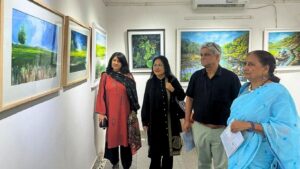
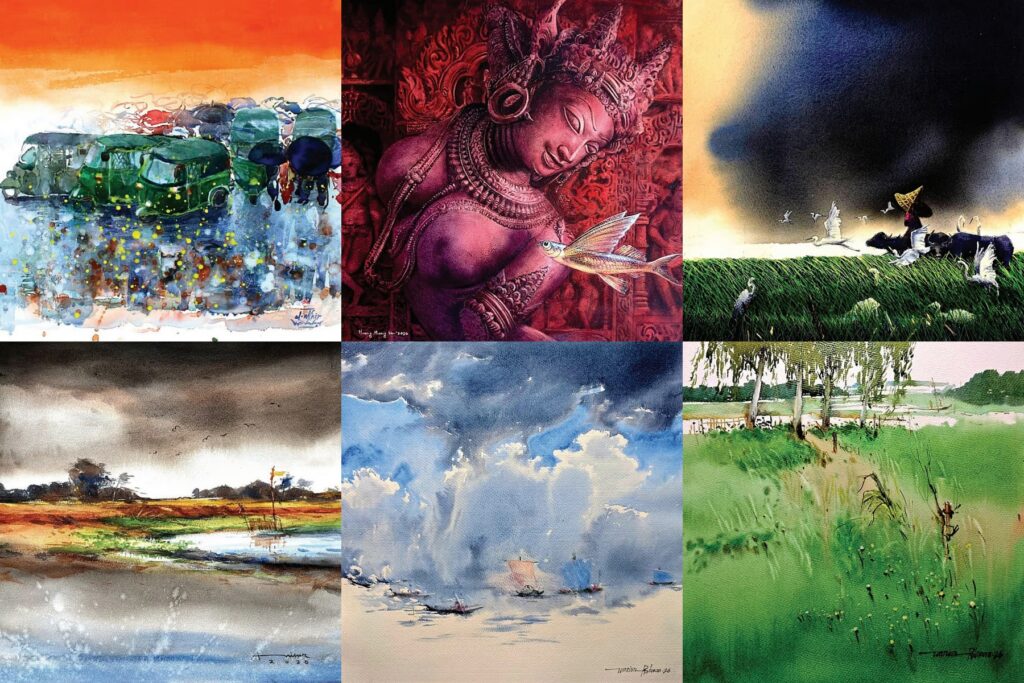
The group exhibition “G-7 (Group Seven)”, organized by Gallery Shilpangan at The Illusion Gallery in Lalmatia, Dhaka, offers a compelling reflection on the diverse possibilities of contemporary watercolour practice in Bangladesh. Featuring seven artists, the exhibition presents a rich visual narrative in which nature, seasons, memory, urban life, and cultural experiences are reinterpreted through the unique language of watercolour.
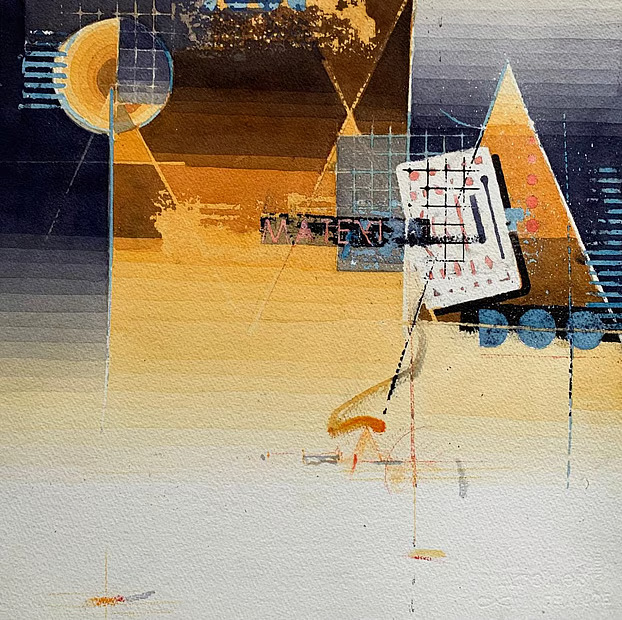
One of the exhibition’s most notable qualities is that, although nature serves as a recurring subject, the participating artists move beyond simple representation. Instead, they reconstruct visible reality through personal perception and artistic experience. As a result, the exhibition functions less as a collection of landscapes and more as a visual diary, where each work reflects the artist’s individual worldview and sensibility.
Among the participants, Warrior Rahman Sami stands out for his evocative depictions of wetlands, cloud formations, and seasonal transformations. In his paintings, nature transcends mere scenery and becomes an immersive emotional experience. Through delicate layers of colour and atmospheric treatment, he creates images that prioritize mood over descriptive detail. In Arrival of the Monsoon, the dramatic movement of clouds, subtle shifts of light, and expansive sky evoke a romantic grandeur. The viewer encounters not simply a landscape but the psychological anticipation of the rainy season itself.
Anisur Rahman’s Monsoon series demonstrates the fluid and spontaneous qualities inherent in watercolour. The strength of his work lies in its restraint and simplicity. Transparent washes, nuanced tonal transitions, and the expressive use of wet surfaces lend his paintings a poetic character. Whether depicting rural landscapes or rain-soaked urban streets, he captures the transient atmosphere of monsoon life with remarkable sensitivity, remaining faithful to the essential nature of the medium.
The works of Al Akhir Sarkar introduce a distinct aesthetic position within the exhibition. His paintings are characterized by dense colour application, strong structural compositions, and a commanding visual presence. Rather than emphasizing the conventional transparency associated with watercolour, he explores the medium’s capacity for depth and dramatic intensity. In Wet Evening in the City, the familiar urban landscape is transformed into a realm of memory and emotion. His work demonstrates that watercolour can be both delicate and powerful, capable of producing visually compelling statements.
In contrast, Azmir Hossain approaches watercolour through a disciplined balance of drawing and colour. Draftsmanship plays a central role in his practice, yet it never overwhelms the expressive potential of paint. Instead, line and colour exist in a harmonious relationship. In his Sakrain and Monsoon series, cultural memory and everyday experience are rendered with contemplative sensitivity. Through controlled washes and carefully observed light, he transforms ordinary scenes into meditative visual experiences.
Perhaps the most conceptually intriguing works in the exhibition are those of Mongmongso. His recurring motif of flying fish functions as a powerful visual metaphor within contemporary Bangladeshi watercolour practice. By juxtaposing traditional sculpture, cultural memory, and symbolic imagery, he creates a pictorial language that blurs the boundaries between reality and imagination. The interaction between airborne fish and static sculptural forms generates a poetic dialogue between movement and permanence, past and present. In his work, watercolour becomes more than a medium—it evolves into a vehicle for philosophical reflection and personal inquiry.
Taken as a whole, the G-7 Watercolour Exhibition is more than a group show; it is a significant document of the current state and future potential of watercolour practice in Bangladesh. The participating artists demonstrate that watercolour is not merely a means of depicting nature but a sophisticated visual language through which memory, identity, culture, time, and emotion can be explored. By embracing both tradition and experimentation, the exhibition reaffirms the enduring relevance of watercolour and highlights its capacity to generate new aesthetic possibilities within contemporary art discourse.
Exhibition: G-7 (Group Seven) Watercolour Exhibition
Venue: The Illusion Gallery, 2/6, Block-C, Lalmatia, Dhaka, Bangladesh
Organizer: Gallery Shilpangan
Duration: 17–25 July 2026