
written by: News Desk
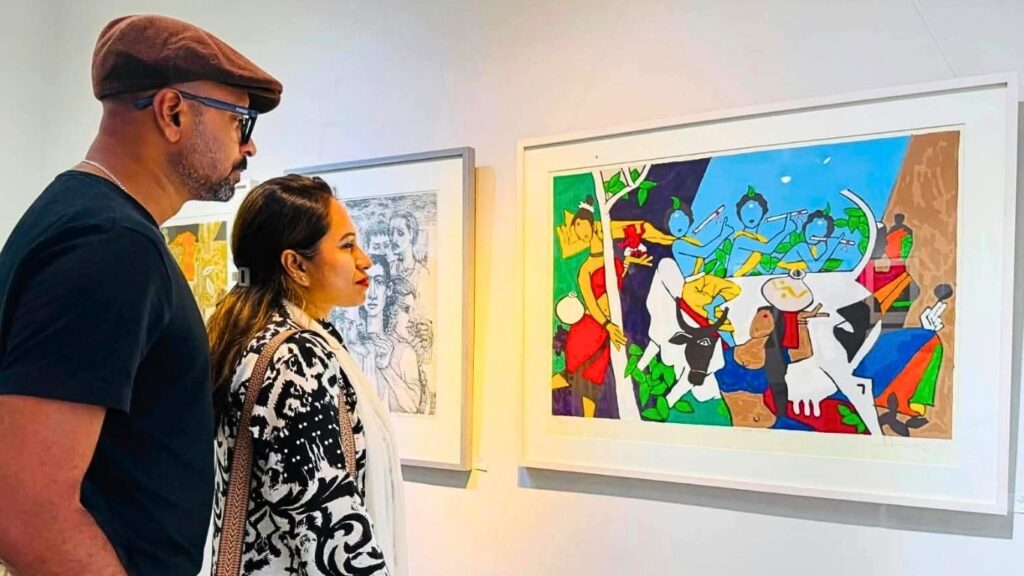
A line can become a human face, a print can carry the scars of time, while a mark carved into wood or etched onto metal can quietly preserve a fragment of history. Bringing together such diverse approaches under one roof, ‘Art Democratic’, a group exhibition at Galleri Kaya, presents a cross-generational dialogue through the language of modern and contemporary art.
The exhibition, featuring 82 selected works by 14 prominent artists from Bangladesh and India, opened last Friday at Galleri Kaya in Uttara. With printmaking at its core, the exhibition brings together a wide range of techniques, including lithography, offset lithography, etching, aquatint, woodcut, serigraph, mezzotint and wood engraving.
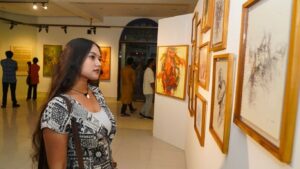
Entering the exhibition space, the diversity of medium and visual expression immediately becomes apparent. Lines, tonal contrasts, textures and carefully constructed forms unfold across paper, creating distinct visual worlds. Each print carries its own material character, while together the works offer a broad view of the varied trajectories of modern and contemporary art practice.
A Dialogue Across Generations
One of the exhibition’s defining strengths lies in its selection of artists. The works of legendary Indian artists M. F. Husain, K. G. Subramanyan, Ramkinkar Baij, Sanat Kar, Ajit Seal and Jogen Chowdhury are presented alongside works by leading Bangladeshi artists Rafiqun Nabi, Shahabuddin Ahmed, Kalidas Karmakar, Mahmudul Haque, Nitun Kundu, Anisuzzaman, Kamruzzaman Sagar and Nagarbasi Barman.
Bringing artists from different generations and artistic traditions into a shared exhibition space creates an opportunity to trace changing approaches to image-making, aesthetics and visual thought. Their works differ in subject, composition, line, form and technique, yet their coexistence reveals a broader continuum within South Asian modern and contemporary art.
The exhibition therefore invites viewers to look beyond individual works and consider the relationships between them—between generations, artistic vocabularies and shifting ideas of representation.
The Language of Printmaking
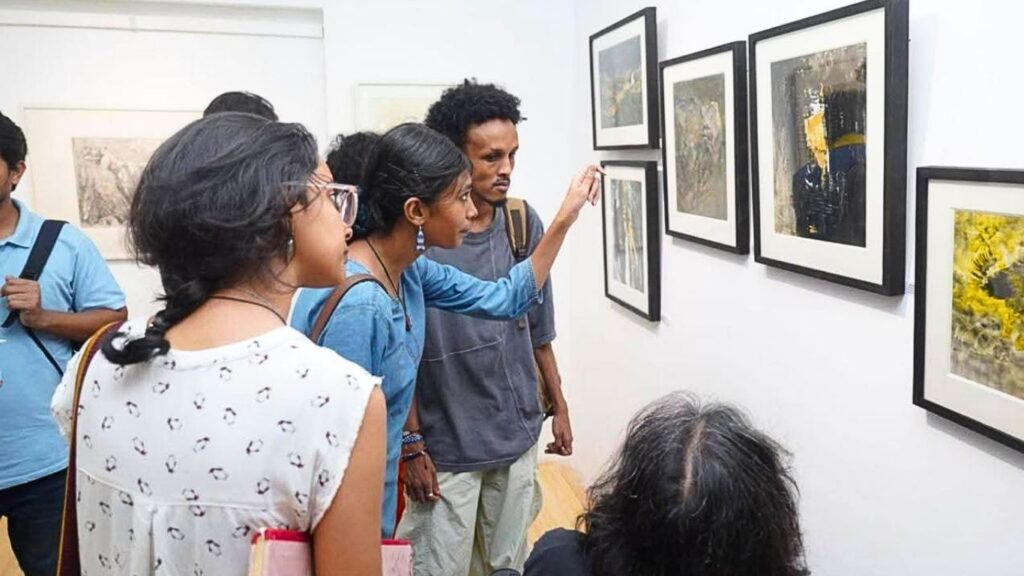
The 82 works demonstrate the remarkable range of possibilities within printmaking. The tonal subtlety of lithography, the precision of etching, the atmospheric depth of aquatint, the graphic strength of woodcut, the tonal richness of mezzotint and the intricate detailing of wood engraving each lend a distinctive character to the works.
Printmaking occupies a unique position within art history, combining technical discipline with the artist’s individual sensibility. In ‘Art Democratic’, this balance emerges differently across the works. In some, the physical qualities of the medium become central to the visual experience; in others, technique recedes behind the artist’s subject, memory or personal vision.
This diversity also resonates with the title ‘Art Democratic’. No single medium, generation or artistic vocabulary dominates the exhibition. Instead, different practices, experiences and technical approaches coexist within the same space, retaining their individual identities while contributing to a larger artistic conversation.
Art Practice and the Reality of the Art Market
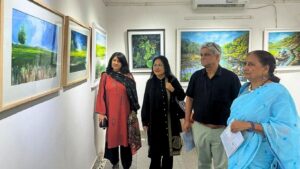
The opening ceremony also brought attention to the broader realities surrounding art practice and the art market in Bangladesh. Eminent economist and former adviser Professor Wahiduddin Mahmud attended the event as the chief guest, while renowned artist Hashem Khan joined as the guest of honour.
Professor Wahiduddin Mahmud observed that although the number of artists and the volume of creative production in Bangladesh have steadily increased, the country’s art market has not developed at the same pace. He pointed to the relatively limited commercial infrastructure and collector base for art, noting that the gap between artistic production and market demand remains a significant challenge to the sustainability of creative practices.
Artist Goutam Chakraborty, founder of Galleri Kaya, said the exhibition brings together selected works by eminent artists from Bangladesh and neighbouring India. The initiative, he noted, offers viewers an opportunity to encounter diverse artistic practices and generations within a single exhibition.
Part of Galleri Kaya’s Continuing Journey
Established in 2004, Galleri Kaya has developed into an active platform for exhibitions and artistic exchange in Bangladesh. Over the years, the gallery has hosted more than 160 exhibitions, along with art trips, art camps and workshops.
In this continuing journey, ‘Art Democratic’ brings together multiple strands of modern and contemporary art within a shared exhibition context. By focusing particularly on the diverse techniques of printmaking, the exhibition allows viewers to experience not only the visual richness of the works but also the material, technical and historical dimensions of the medium.
The exhibition is open to visitors daily from 11:30 am to 8:00 pm at Galleri Kaya. Art enthusiasts, collectors and general visitors can explore the exhibition until 31 August.
The exhibition is sponsored by ADN Group.