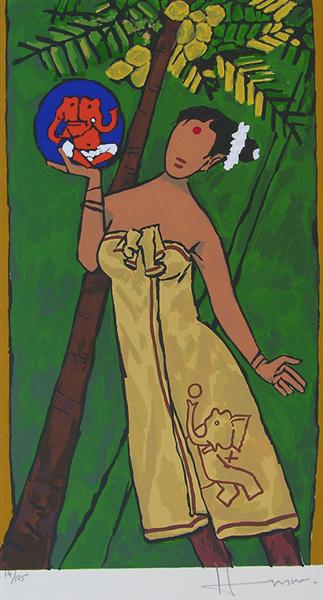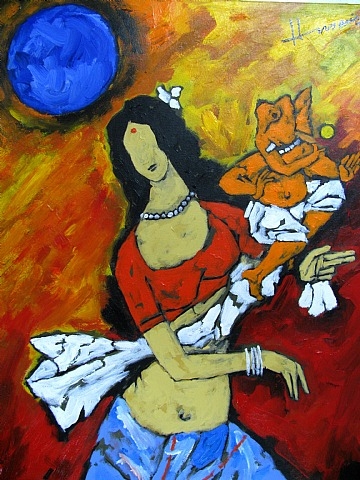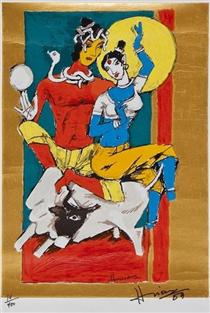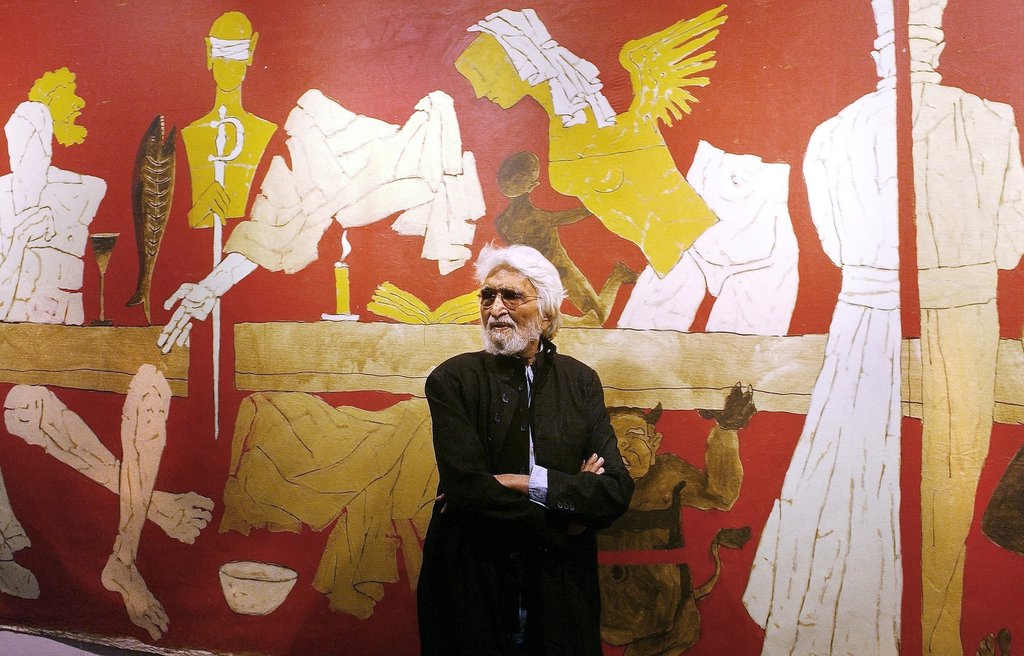

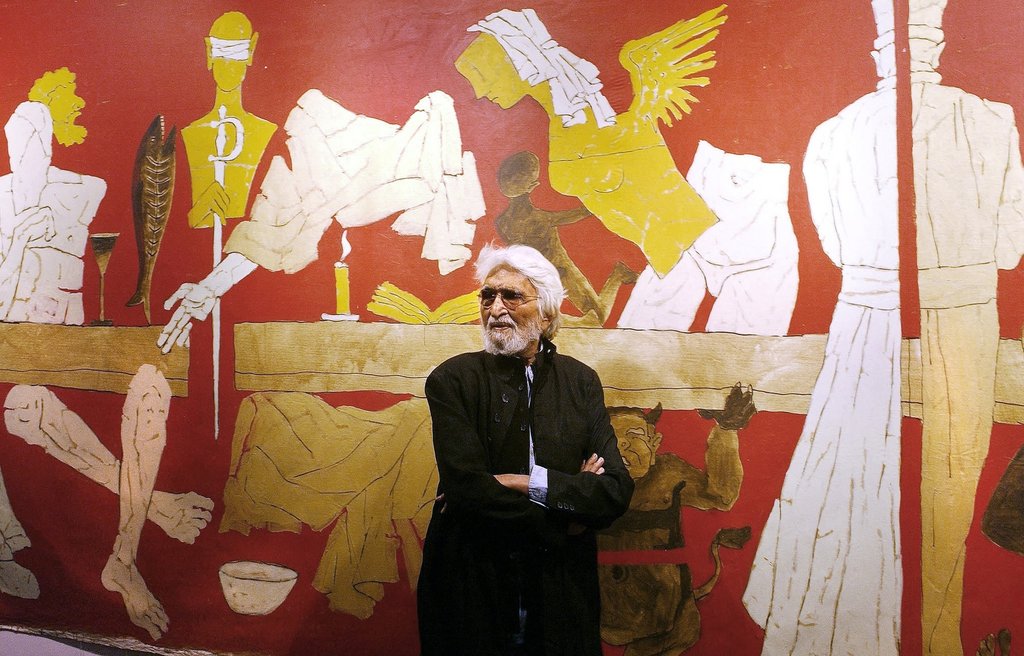
Maqbool Fida Husain (1915–2011), popularly known as M.F. Husain, was one of the most celebrated and controversial figures in Indian modern art. Widely regarded as the ―Picasso of India,‖ Husain’s artistic journey spanned more than seven decades, marked by innovation, bold expression, and a fearless exploration of cultural and political themes. His work brought Indian modernism onto the global stage, blending traditional Indian motifs with a vibrant, contemporary aesthetic that captivated audiences worldwide.
Education and Early Life
Born on September 17, 1915, in Pandharpur, Maharashtra, Husain lost his mother at a young age, an event that would deeply affect his emotional world. He moved to Indore and eventually pursued formal education at the Sir J.J. School of Art in Mumbai (then Bombay) in the 1930s. Before his rise to fame, he earned a living by painting cinema hoardings and designing toys—a phase that deeply influenced the stylistic and theatrical qualities of his later work.
Though Husain’s academic training was limited, he was a voracious learner. He immersed himself in Indian classical art, miniature painting, temple sculptures, and the folk traditions of India. This self-directed education became the foundation of a style that was uniquely his own.
Painting Form and Medium
M.F. Husain worked across a wide variety of forms and mediums. Though he was primarily a painter, he also worked in drawing, printmaking, sculpture, and even filmmaking. His paintings were typically done in oil on canvas, but he also used acrylics and watercolors in later years. He was known for working at a rapid pace—often producing massive murals and completing large canvases with great speed and energy.
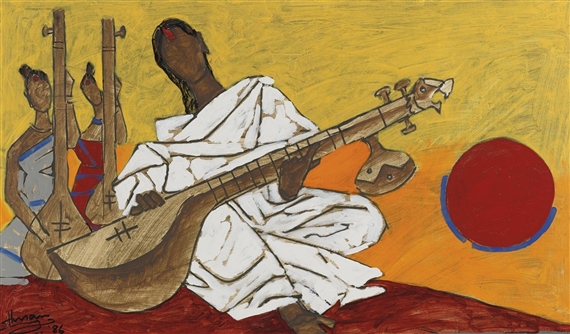
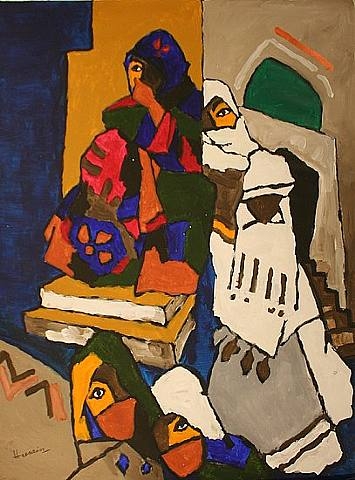
Husain’s paintings are instantly recognizable for their bold, calligraphic lines, abstracted human and animal figures, and simplified but dramatic forms. His work was narrative yet symbolic, combining storytelling with a strong formal emphasis on composition and movement.
Colour Palette
Husain’s use of color was as expressive as it was symbolic. He favored earthy, vibrant hues—reds, yellows, blues, and blacks—that conveyed emotion and mythological resonance. His palette was both traditional and modern. He drew from the vibrant colors of Indian folk art and miniature paintings but employed them with a modernist sensibility. In his later works, his color usage became even more experimental, with high contrasts and flat planes of color reflecting shifts in both emotion and theme.
The raw power of his colors—neither overly polished nor hesitant—reflected his deep belief in spontaneity. This, coupled with his energetic brushwork, gave his paintings a sense of life and motion that connected deeply with viewers.
Themes and Motifs
Husain’s themes were vast and deeply rooted in Indian culture, history, and mythology. Among the major subjects he explored:
- Indian Epics and Mythology: Husain frequently returned to stories from the Ramayana, Mahabharata, and Puranas. Characters like Draupadi, Ganesha, and Krishna appeared repeatedly in his work, depicted in stylized forms that combined reverence with personal interpretation.
- Motherhood and Femininity: The figure of the woman—both divine and mortal—was central to his work. From goddesses to everyday women, Husain explored motherhood, sensuality, suffering, and strength through female figures. This theme often led to controversies when traditional icons were portrayed in nude or semi-abstract forms.
- Historical and Political Narratives: He created works based on India’s independence movement, leaders like Gandhi and Nehru, and events like the partition. His painting “Bharat Mata” (Mother India) and depictions of Muslim and Hindu unity were examples of his political engagement.
- Cinema and Popular Culture: Deeply fascinated by film, Husain idolized actress Madhuri Dixit and even made a film, Gaja Gamini (2000), with her. The glamour and fantasy of Indian cinema made their way into his canvases in vibrant, theatrical ways.
- Global and Religious Synthesis: In his later years, Husain’s work took on more international themes, including series on Arabia, Quranic verses, and comparisons between Indian and Western cultures.
Style and Influences
Stylistically, Husain was part of the Progressive Artists’ Group (PAG), founded in 1947 in Bombay, which sought to break from colonial academic traditions and create a modern Indian idiom. The group included artists like F.N. Souza, S.H. Raza, and Tyeb Mehta. Though influenced by Western modernists such as Picasso and Matisse, Husain’s work was uniquely Indian in tone and theme.
His style was:
- Figurative and Abstract: His figures, whether divine or human, were abstracted to simple shapes and gestures, yet retained narrative clarity.
- Expressive and Spontaneous: Husain valued speed and intuition in his art. He painted barefoot and often sat on the floor, using long brushes in sweeping motions.
- Mythic and Political: Few artists managed to blend the mythic and the contemporary as fluidly as Husain did.
Awards and Honors
Over his long career, M.F. Husain received numerous awards and accolades:
- Padma Shri (1966)
- Padma Bhushan (1973)
- Padma Vibhushan (1991), the second-highest civilian award in India
- National Film Award for Best Experimental Film (Through the Eyes of a Painter, 1967)
- Honorary Doctorates from universities across India
- Elected to the Rajya Sabha, India’s Upper House of Parliament, in 1986
His contribution to modern Indian art is considered foundational, and his influence has shaped generations of artists.
Controversies and Exile
Husain’s artistic boldness also made him a controversial figure. His nude and semi-abstract depictions of Hindu deities drew protests and legal action from right-wing Hindu groups, particularly in the 1990s and 2000s. Paintings such as Bharat Mata and his representations of goddesses like Saraswati and Durga led to public outrage, vandalism of exhibitions, and death threats.
Faced with ongoing legal battles and protests, Husain went into self-imposed exile in 2006. He lived primarily in Qatar and London during his final years. In 2010, he accepted Qatari citizenship after being effectively exiled from his homeland. Despite the controversies, many intellectuals and artists rallied to his defense, considering his treatment a grave injustice.
Legacy and Death
M.F. Husain passed away on June 9, 2011, in London, at the age of 95. His death marked the end of an era in Indian art. Yet his legacy endures. His paintings continue to fetch record prices at international auctions, and retrospectives of his work are held in major museums and galleries worldwide.
Husain’s contribution was not just in terms of individual works but in creating a space for Indian modern art on the world stage. He inspired not just painters but also writers, filmmakers, and thinkers to blend tradition with innovation, mythology with modernity.
M.F. Husain was not merely a painter; he was a chronicler of India’s cultural, political, and emotional landscapes. His life was as bold and colorful as his art—marked by relentless creativity, unflinching honesty, and a deep love for his homeland. Whether celebrated or criticized, Husain remained committed to his vision, making him one of the most important artists in India’s modern history. His legacy, rooted in both controversy and admiration, continues to inspire and provoke—a hallmark of true art.
Watch our video of Maqbool Fida Husain (Bangla): https://youtu.be/PaBXlSaJo7o