
written by: Suman Biswas
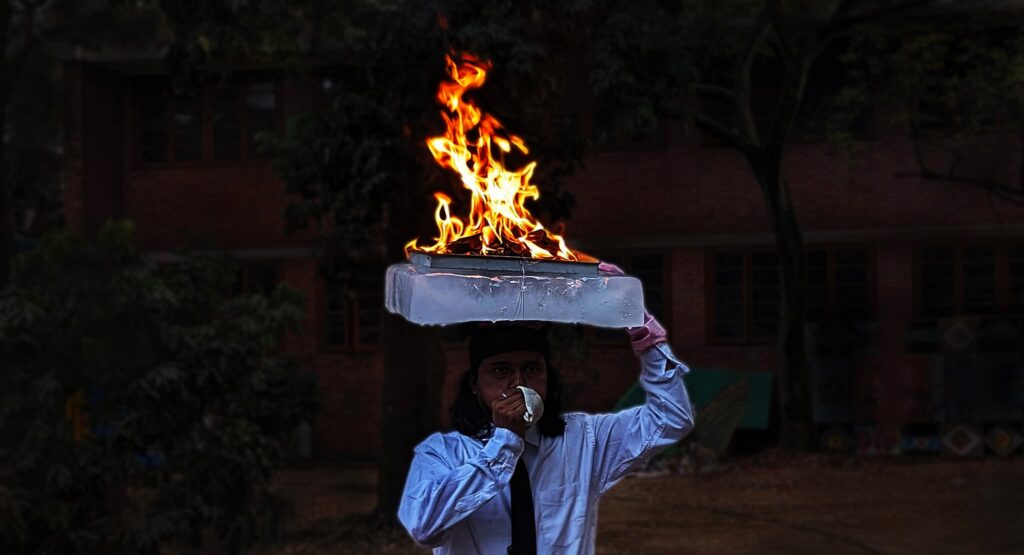
Performance Art Title: The Burning Balance 2;
Duration: 40 minutes;
Place: Dhaka University, Dhaka, Bangladesh-2024
Performance art, as a contemporary artistic medium, transcends traditional forms by using the artist’s body, presence, and actions to convey ideas directly to an audience. Unlike static objects such as paintings or sculptures, performance art unfolds in time and space, emphasizing immediacy, interaction, and experience. Its core elements—time, space, embodiment, and the dynamic relationship between artist and audience—enable it to engage spectators intellectually, emotionally, and aesthetically. This art form is not only a mode of expression but also a vehicle for social commentary, cultural reflection, and personal exploration.
Globally, performance art emerged in the early twentieth century, rooted in avant-garde movements such as Futurism, Dada, Surrealism, Constructivism, and Bauhaus. These movements challenged traditional definitions of art, exploring improvisation, absurdity, and the use of everyday objects as artistic materials. In mid-twentieth-century Europe and the United States, figures such as Yves Klein, Joseph Beuys, Gilbert & George, and Jackson Pollock expanded the boundaries of art by integrating the human body, gestures, and performative actions into their practices. By the 1960s and 1970s, performance art had become a recognized medium worldwide, emphasizing the ephemeral, conceptual, and participatory nature of artistic creation.
In Bangladesh, performance art is a relatively recent phenomenon, yet it has grown steadily over the past three decades. Emerging from informal practices and gradually formalized through workshops, exhibitions, and international collaborations, it reflects both local cultural traditions and international artistic influences. The study of performance art in Bangladesh not only highlights the evolution of a new artistic medium but also underscores the role of art in bridging social, cultural, and aesthetic experiences, allowing artists and audiences alike to engage deeply with the complexities of human existence.
Compared to its global trajectory, performance art arrived in Bangladesh relatively late, yet its development has been marked by innovation, experimentation, and increasing institutional recognition. The roots of performance art in Bangladesh lie in informal, homegrown practices, which drew on both local cultural traditions and the influence of international artistic movements. Folk performances, ritualistic processions, and body-based expressions in Bengali culture offered a conceptual foundation for performance art long before it was formally introduced. Forms such as Mansa Mangal Pala, Gaur-Nitai Jatra, boat races, Nil Nach, and Lal Nach, though not performance art in the contemporary sense, demonstrated fundamental elements of the medium: bodily expression, spatial awareness, audience engagement, and dramatic presence. Similarly, practices associated with religious rituals, festivals, and processions revealed an early understanding of performative embodiment and temporality.
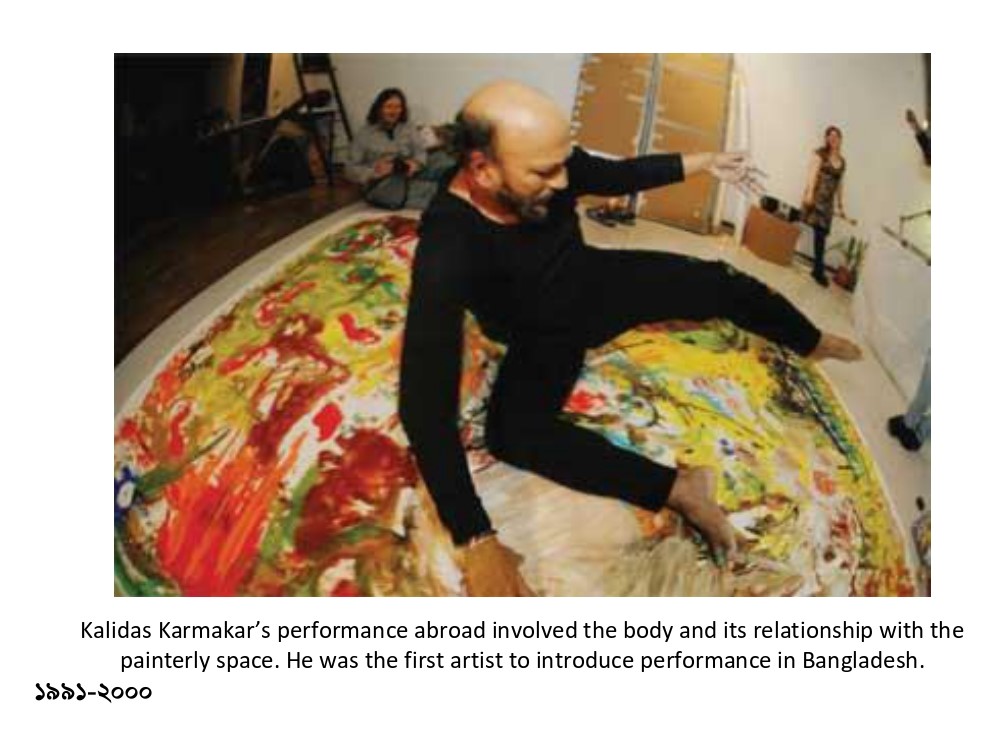
The formal practice of performance art in Bangladesh began to emerge in the late 1980s and early 1990s, spurred by the experimental approaches of pioneering artists such as Kalidas Karmakar, Saleh Mahmud, and Moniruzzaman Shipu. Kalidas Karmakar, widely regarded as a precursor, began exploring performance internationally, collaborating with Partha Pratim Majumder in 1977 for a performance in Paris and presenting a solo work in 1981. Upon returning to Bangladesh, his performances—such as Padma-1near the ferry ghat of Nagarbari—highlighted pressing social and environmental concerns, including river erosion, displacement of communities, and the fragile relationship between people and nature. While these early works incorporated performative elements, Kalidas Karmakar did not formally label them as performance art, yet they laid the conceptual groundwork for subsequent developments.
Performance art, as a contemporary artistic medium, transcends traditional forms by using the artist’s body, presence, and actions to convey ideas directly to an audience. Unlike static objects such as paintings or sculptures, performance art exists in time and space, emphasizing immediacy, interaction, and experience. Its core elements—time, space, embodiment, and the dynamic relationship between artist and audience—allow it to engage spectators intellectually, emotionally, and aesthetically. This art form is not only a mode of expression but also a vehicle for social commentary, cultural reflection, and personal exploration.
Globally, performance art emerged in the early twentieth century, rooted in avant-garde movements such as Futurism, Dada, Surrealism, Constructivism, and Bauhaus. These movements challenged traditional definitions of art, exploring improvisation, absurdity, and the use of everyday objects as artistic materials. In mid-twentieth-century Europe and the United States, figures like Yves Klein, Joseph Beuys, Gilbert & George, and Jackson Pollock expanded the boundaries
of art by integrating the human body, gestures, and performative actions into their practice. By the 1960s and 1970s, performance art became a recognized medium worldwide, emphasizing the ephemeral, conceptual, and participatory nature of artistic creation.
In Bangladesh, performance art is a relatively recent phenomenon, yet it has grown steadily over the past three decades. Emerging from informal practices and gradually formalized through workshops, exhibitions, and international collaborations, it reflects both local cultural traditions and global artistic influences. The study of performance art in Bangladesh not only highlights the evolution of a new artistic medium but also underscores the role of art in bridging social, cultural, and aesthetic experiences, allowing artists and audiences alike to engage deeply with the complexities of human life and society.
Compared to its global trajectory, performance art arrived in Bangladesh relatively late, yet its development has been marked by innovation, experimentation, and increasing institutional recognition. The roots of performance art in Bangladesh lie in informal, homegrown practices, which drew on both local cultural traditions and the influence of international artistic movements. Folk performances, ritualistic processions, and body-based expressions in Bengali culture offered a conceptual foundation for performance art long before it was formally introduced. Forms such as Mansa Mangal Pala, Gaur-Nitai Jatra, boat races, Nil Nach, and Lal Nach, though not performance art in the contemporary sense, demonstrated fundamental elements of the medium: the use of the body, audience engagement, spatial awareness, and dramatic presence. Similarly, practices associated with religious rituals, festivals, and processions revealed an early understanding of performative embodiment and temporality.
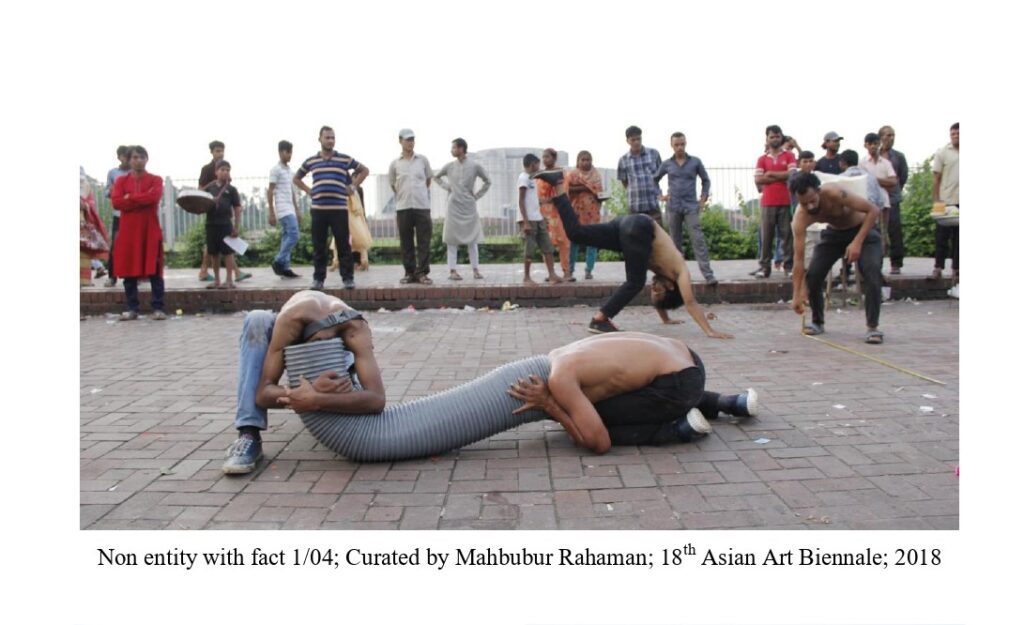
The formal practice of performance art in Bangladesh began to emerge in the late 1980s and early 1990s, spurred by the experimental approaches of pioneering artists such as Kalidas Karmakar, Saleh Mahmud, and Moniruzzaman Shipu. Kalidas Karmakar, widely regarded as a precursor, began exploring performance internationally, collaborating with Partha Pratim Majumder in 1977 for a performance in Paris and presenting a solo work in 1981. Upon returning to Bangladesh, Kalidas Karmakar’s performances—such as Padma-1 near the ferry ghat of Nagarbari—highlighted pressing social and environmental issues, including the devastating effects of the Farakka Barrage on riverine communities. While these early works incorporated performative elements, Kalidas Karmakar did not formally label them as performance art, yet they laid the conceptual groundwork for subsequent developments.
A critical moment in the formalization of performance art occurred in the early 1990s with the arrival of German artist Christian Rothman. In 1992, the Bangladesh Shilpakala Academy and the Goethe Institute jointly organized a ten-day workshop with Rothman, attended by sixteen Bangladeshi artists, including Dhali Al Mamun, Dilara Begum Jolly, Nilufar Chaman, Sanjib Dutta, and Nazli Laila Mansur. Through presentations of European contemporary art, screenings of documentaries, and hands-on exercises, Rothman introduced participants to the possibilities of installations, happenings, and performance-based artistic experimentation. The workshop encouraged local artists to expand their practice beyond conventional painting and sculpture, emphasizing process, temporality, and the body as a medium. The experience fostered an experimental ethos and created a network of artists eager to explore this emerging form.
In 1994, Mahbubur Rahman formally presented the first recognized performance art in Bangladesh in Lama, Bandarban. His work engaged all four core elements of performance art—time, space, the artist’s body, and audience interaction—illustrating the medium’s capacity to transform everyday experience into aesthetic and conceptual expression. Following Rahman’s pioneering example, Moniruzzaman Shipu performed Green Man and Saleh Mahmud presented Surakshito Bandishala at the Faculty of Fine Arts, University of Dhaka during Pohela Boishakh, creating a new atmosphere within the local art community.
These early works combined site-specificity, social commentary, and physical embodiment, offering audiences novel ways of engaging with contemporary art.
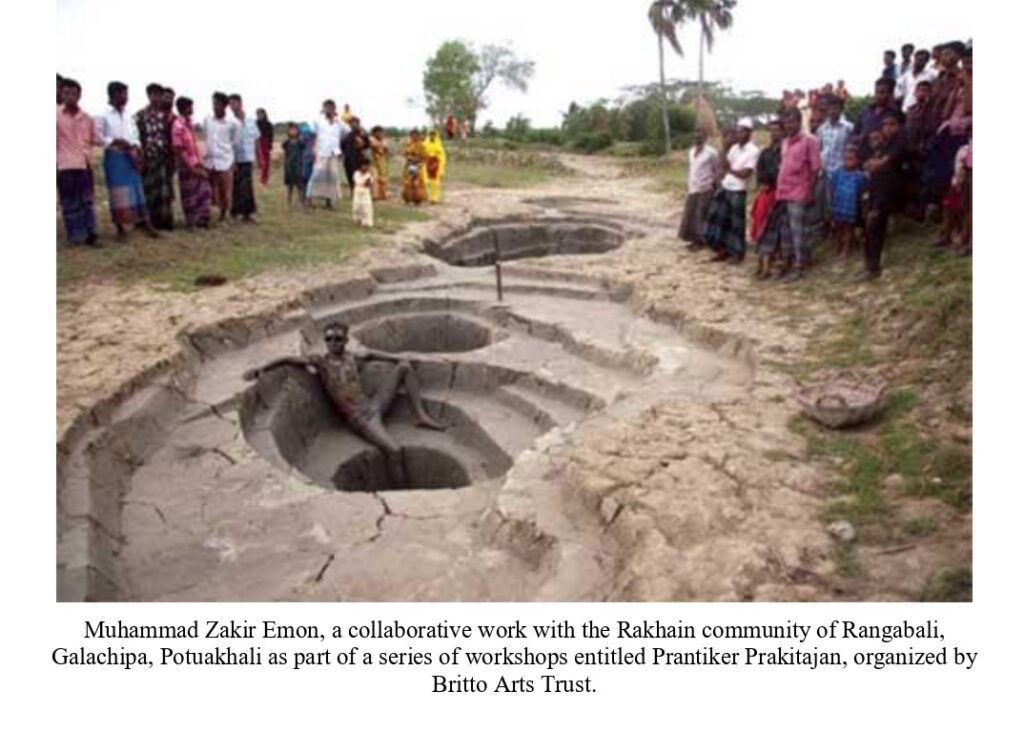
From 1997 to 2000, artists such as Emran Sohel and Muhammad Zakir Emon further explored site-specific, unthemed performances around Dhaka University, including Shahbagh, TSC, Sohrawardi Udyan, and Molla’s Tea Stall. These works emphasized spontaneity, humor, and immediate audience reaction, highlighting the relational dynamics central to performance art. The artists’ focus on urban spaces and public accessibility reflected an evolving understanding of performance as socially engaged practice.
Workshops and collaborations during the 1990s played a crucial role in consolidating performance art as a recognized medium in Bangladesh. These events not only introduced local artists to contemporary international practices but also created networks that would sustain the growth of the medium into the 2000s. The emphasis on experimentation, bodily engagement, and site specificity became defining characteristics of Bangladeshi performance art, distinguishing it from traditional visual arts while maintaining strong connections to local cultural and ritualistic practices.
By the end of the 1990s, the foundation for performance art in Bangladesh was firmly established. Pioneering figures, key workshops, and early site-specific works collectively created an emerging vocabulary and methodology. Artists began to view the body as a medium capable of conveying political, social, and aesthetic messages, while audiences were invited to become active participants in the creation of meaning. This formative period set the stage for the subsequent expansion of performance art in Bangladesh, characterized by increasing experimentation, international collaboration, and institutional recognition.
The 1980s and 1990s thus represent a critical phase in the evolution of Bangladeshi performance art. From informal cultural practices to structured workshops and public presentations, the medium developed a unique identity, blending global influences with local sensibilities. This era not only introduced the foundational principles of performance art to Bangladesh but also nurtured a generation of artists who would propel the medium forward, bridging the gap between traditional visual arts and contemporary performative experimentation.
The first decade of the twenty-first century marked a period of significant growth and consolidation for performance art in Bangladesh. During this time, the practice moved from informal experimentation into a more structured, collaborative, and institutionally supported form, shaped by the efforts of pioneering artists, the establishment of art collectives, and exposure to international artistic practices. Performance art began to gain visibility as a medium capable of addressing social, political, and cultural concerns while engaging directly with audiences in both urban and rural contexts.
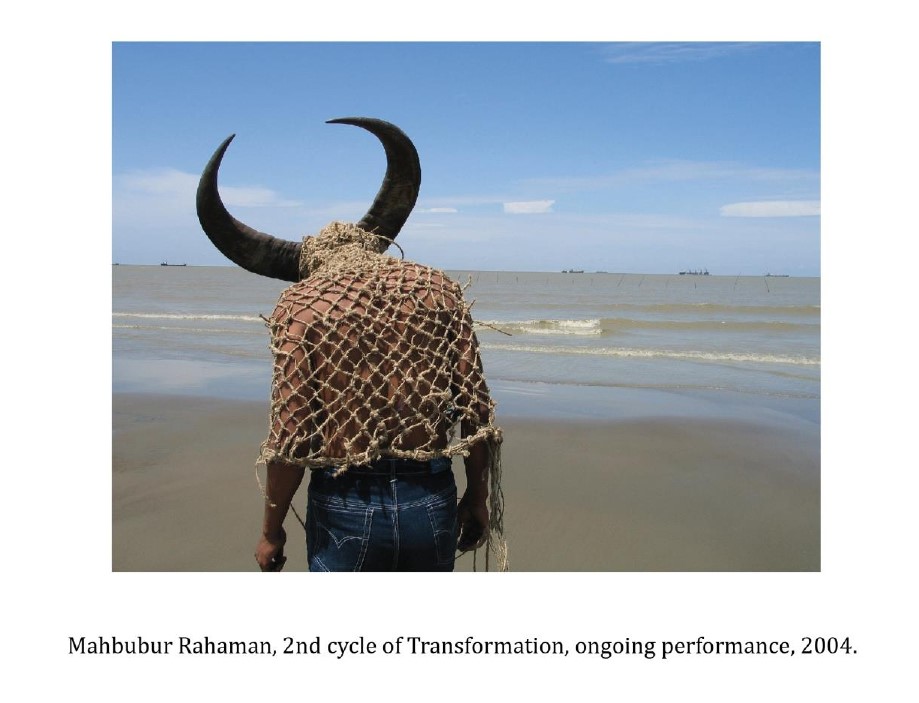
Around 2003–2004, Mahbubur Rahman played a pivotal role in facilitating the expansion of performance art in Bangladesh. His efforts brought international artists to the country, introducing new methodologies and perspectives to a growing local community. French artist Ayona Cozent visited Chittagong at Rahman’s invitation, and together they organized a performance art workshop titled Movement Will Become Sculpture at the Jagatpur Ashram in Rauzan. This workshop, attended by emerging Bangladeshi artists including Abu Naser Robi, Monjur Ahmed, Nur-e-Ilahi, Joydeb Roaza, Shatabdi Som, and Bipul Saha, represented one of the first organized performance art training programs in Bangladesh. Participants experimented with using their bodies as sculptural forms, integrating movement, props, and conceptual ideas, which significantly broadened the creative vocabulary available to local artists. For instance, Abu Naser Robi and Mahbubur Rahman constructed upper-body masks from ropes, Joydeb Royaja created revolving cardboard masks to convey shifting emotions, and Bipul Saha fashioned wearable rope-based structures for performative action. Each artist explored themes ranging from political oppression and social norms to the environmental and spiritual dimensions of life, reflecting a deep engagement with local concerns while employing experimental, international techniques.
This period also saw the formation of performance art collectives, which institutionalized practice and provided a platform for sustained experimentation. The Porapara Space for Artists, founded by Abu Naser Robi, and the Santaran Art Organization, established by Manjur Ahmed, Bipul Saha, Shatabdi Som, and Tanzil Fatema Tusi, became critical hubs for collaboration, workshop activity, and public engagement. These collectives nurtured young artists, encouraging them to experiment with site-specific, socially relevant performances that emphasized bodily expression, temporality, and audience interaction. The workshops and events organized by these groups laid the groundwork for performance art’s increasing institutional recognition in Bangladesh.
In 2009, Porapara organized the country’s first performance art workshop entirely devoted to the medium, attracting a promising new generation of artists who had already demonstrated a commitment to contemporary art practices. Discussions during the workshop addressed fundamental aspects of performance art, including human life, social values, survival, gender identity, domestic violence, human rights, and environmental awareness. Participants such as Shayla Sharmin, Arifuzzaman, Ripon Saha, Farah Naz Mun, Joydeb Roaza, and Palash Bhattacharya used performance as a means of both artistic expression and social critique. The workshop emphasized experimentation, collaboration, and the ethical responsibilities of artists, fostering a dynamic and socially conscious approach to the medium.
The following year, 2010, marked another significant milestone through collaboration with Japanese performance artist Seiji Shimuda. Shimuda conducted a three-day workshop in Chittagong, fully funding his participation, which allowed Bangladeshi artists to engage directly with international performance practices. The workshop featured techniques, strategies, and discussions that strengthened the conceptual and practical understanding of performance art, bridging local and global perspectives. Participants, including Syeda Karimunnesa, Nilufar Chaman, Dilara Begum Jolly, Palash Bhattacharya, Abu Naser Robi, Joydeb Roaza, and many others, were exposed to methods that emphasized simplicity, immediacy, and audience engagement. Shimuda’s presence and mentorship helped formalize performance art education in Bangladesh, offering a model for future workshops and international collaborations.
The late 2000s also witnessed the integration of performance art into public events and festivals, further establishing its institutional legitimacy. For example, the joint initiatives of Visiting Arts and Britto Arts Trust facilitated public art projects in Madhupur, exposing broader audiences to performance-based works. Such projects underscored the capacity of performance art to communicate social and political messages, transform urban and rural spaces, and cultivate dialogue between artists and communities.
Throughout this period, performance art in Bangladesh began to exhibit a distinct identity, blending global influences with local cultural and ritualistic traditions. While drawing on international techniques introduced by Mahbubur Rahman, Cozent, and Seiji Shimoda, Bangladeshi artists incorporated indigenous narrative forms, mythological motifs, and site-specific references to engage audiences in culturally resonant ways. Public spaces, university campuses, and urban streets became sites for experimentation, while workshops, collectives, and international collaborations provided the infrastructure needed for sustained growth.
By the end of the decade, performance art in Bangladesh had moved from sporadic experimentation to a recognized, institutionalized practice. Workshops, collectives, and public performances created a networked ecosystem that encouraged both creative innovation and critical reflection. Artists gained confidence in using the body as a medium, exploring themes that ranged from political oppression and environmental crises to social justice and identity. Collectives such as Porapara and Santaran ensured continuity and mentorship, cultivating a generation of artists who would carry the practice into the following decade with increasing sophistication and social relevance.
The decade from 2010 to 2020 witnessed the consolidation of performance art as a recognized and influential medium in Bangladesh. Building on the foundational efforts of the previous decade, this period was characterized by increasing institutional support, the formalization of training programs, expanded international collaborations, and the emergence of performance art festivals, all of which contributed to a sustained expansion of the practice. Performance art, once confined to informal experimentation, now assumed a more visible and socially engaged presence, highlighting the potential of the body as a site of artistic, political, and cultural expression.
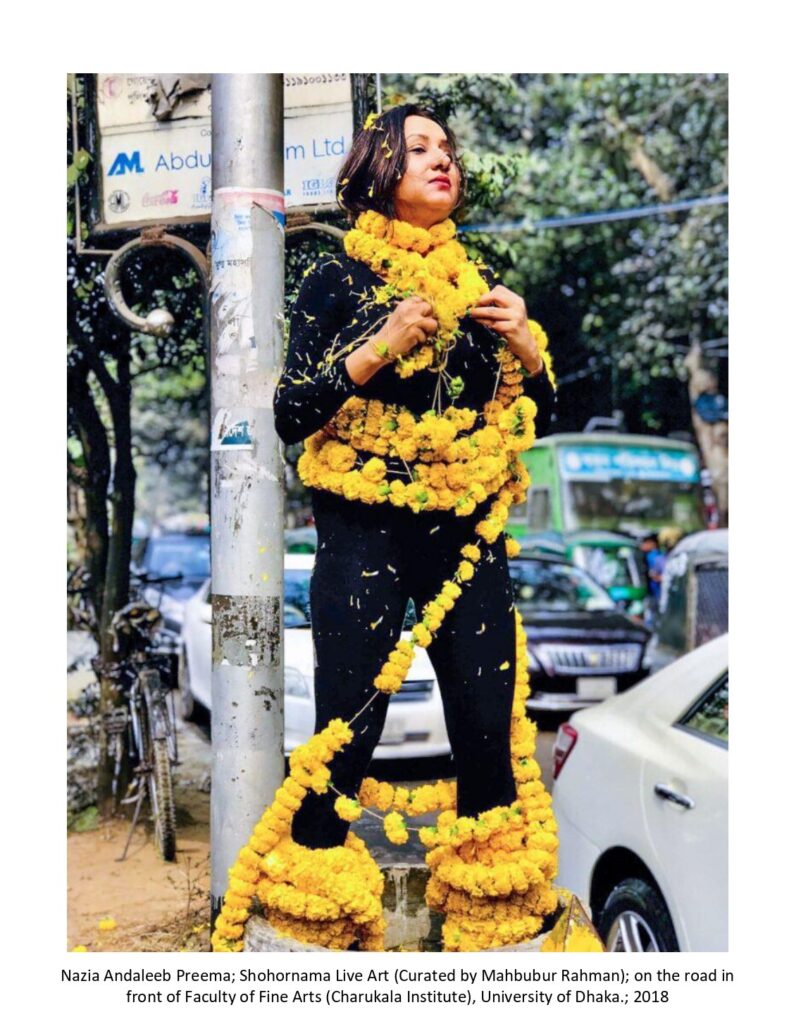
A defining moment in this period was the establishment of Porapara Space for Artists and the Santaran collective as central hubs for performance art in Chittagong. These collectives not only provided artists with studio spaces and resources but also acted as platforms for mentorship, experimentation, and public engagement. They emphasized the integration of conceptual rigor with bodily practice, encouraging young artists to explore site-specific works, social commentary, and performative interventions in both urban and rural contexts. Workshops and collaborative projects organized by these collectives helped cultivate a generation of artists adept at addressing complex societal issues through live action, thereby fostering a socially responsive and critically aware practice.
International exposure played a crucial role in this consolidation phase. In 2010, Japanese performance artist Seiji Shimoda conducted a three-day workshop in Chittagong, establishing a vital link between Bangladeshi and global performance art communities. Shimuda’s approach emphasized simplicity, immediacy, and the relational dynamics between the artist and audience. This interaction not only enriched the technical and conceptual vocabulary of Bangladeshi artists but also highlighted the importance of cross-cultural collaboration in fostering innovation and contextual adaptation. Shimuda returned in 2011 to support the first International Performance Art Festival in Bangladesh, hosted jointly by Porapara Space for Artists and his own organization. This festival, staged across Chittagong and Dhaka, included approximately fifty-five artists from Bangladesh, Japan, and Korea and featured over 250 performances. Renowned artists like Osamu Kuroda further elevated the festival’s profile, exposing Bangladeshi audiences to diverse international practices while simultaneously providing local artists with an opportunity to situate their work within global dialogues.
Alongside international engagements, performance art in Bangladesh became increasingly intertwined with social and cultural activism. Initiatives such as Amader Bhasha, Amader Shahid (Our Language, Our Martyrs), organized annually by the Lal group beginning in 2011, exemplify the medium’s ability to bridge art, history, and public consciousness. In these performances, artists adorned in white masks and clothing inscribed with the Bengali alphabet processioned from Bangla Academy to Shaheed Minar on 21 February, commemorating the martyrs of the Bengali Language Movement. Each year’s performance adopted a specific thematic focus, ranging from national leaders and literary icons to socio-political issues and cultural heritage, fostering an immersive, participatory experience that resonated with thousands of observers. The project demonstrated the capacity of performance art to act as a living memorial, merging aesthetic, social, and political dimensions while reinforcing collective memory and identity.
During this decade, institutional recognition of performance art further accelerated its consolidation. Notable initiatives included the Bengal Foundation’s Performance Art Week from 27–30 December 2016, which provided a multi-gallery platform for emerging and established artists to explore socially engaged, politically informed, and conceptually driven performances. The event underscored performance art’s dual role as both an aesthetic and socially responsive practice, emphasizing the integration of conceptual innovation with public engagement.
The decade also saw the emergence of large-scale public biennales, most notably the Dhaka Live Art Biennale (D’LAB), initiated in 2017 by the Back Art Foundation. This international platform emphasized live art in its broadest sense, encompassing performance, experimental theater, dance, voice, and action video art. Over multiple editions, the biennale attracted over 100 artists from 26 countries, providing a space for diverse practices to engage directly with Bangladeshi audiences. The biennale’s focus on audience interaction, performative experimentation, and social relevance solidified performance art’s position within the national artistic landscape, encouraging young artists to explore the medium while fostering an appreciation of contemporary art practices among the general public. According to Shubho Saha, president of Back Art Foundation, the biennale has not only inspired emerging artists but also positively impacted local culture and the economy by creating opportunities for cultural tourism and public engagement.
Since 2020, performance art in Bangladesh has entered a dynamic phase characterized by both consolidation and innovation. The Bangladesh Shilpakala Academy formally included performance art under its awards category, highlighting works by artists. With institutional recognition firmly established, artists increasingly experiment with hybrid forms, integrating digital media, interactive installations, and socially engaged practices. Contemporary performance artists in Bangladesh emphasize public engagement and activism, Similarly, ecological and feminist concerns have gained prominence, with works addressing climate change, urbanization, environmental degradation, and gender justice. Global recognition has also grown. Emerging artists increasingly pursue residencies, fellowships, and exhibitions abroad, while international festivals and collaborations continue to introduce Bangladeshi perspectives to a global audience.
Performance art today serves as a medium through which local and global discourses intersect. It embodies immediacy, relationality, and bodily expression, maintaining its capacity to provoke reflection, challenge norms, and foster dialogue. From socially engaged street performances to curated international exhibitions, the medium has evolved into a versatile platform that unites artistic experimentation, cultural commentary, and public participation. By bridging tradition, modernity, and global artistic currents, contemporary performance art in Bangladesh reflects the nation’s creative vitality, asserting itself as both a mirror of society and a catalyst for cultural transformation.
The evolution of performance art in Bangladesh reflects a remarkable journey from informal, experimental beginnings to a recognized, institutionally supported, and internationally engaged art form. Rooted in the global avant-garde movements of the twentieth century, it arrived in Bangladesh through pioneering artists such as Kalidas Karmakar and Mahbubur Rahman, gradually inspiring collectives, workshops, and festivals. Over time, performance art has expanded beyond galleries into public spaces, linking aesthetic innovation with social, political, and cultural engagement.
From the early experimentation of the 1990s to the consolidation and international exposure of the 2010s, and the socially conscious, globally connected practices of today, performance art in Bangladesh has matured while retaining its immediacy, relationality, and performative vitality. Artists employ their bodies as both medium and message, transforming lived experience into collective engagement. By bridging tradition, modernity, and contemporary global discourse, performance art has become a vital vehicle for creative expression, social commentary, and cultural dialogue.
Ultimately, the trajectory of performance art in Bangladesh demonstrates how artistic innovation can thrive within local contexts while resonating internationally. It underscores the power of art to foster awareness, challenge norms, and cultivate connections across communities, solidifying its role as a transformative and enduring component of Bangladesh’s contemporary art landscape.
References:
Goldberg Rosellee; Performance Art From Futurism to the Present; Third edition; Thames & Hudson world of art; 2011; Page: 7-30, 128-128.
https://www.en.wikipedia.org/wiki/performance-art.
www.imma.ie/en/downloads/whatisperformanceart.pdf.
www.departmag.com/index.php/en/detail/262/socio-aesthetic-genesis-performance-art.
www.departmag.com/index.php/en/detail/460/the-turning-of-the-tide-and-bengaland-performance-art-week-at-a-glance.
www.biennialfoundation,org/biennals/dhaka-live-art-biennale-bangladesh.
www.backart.org/dhaka-live-art-biennale-2019-2.
www.samdani.com.bd/blog/2019/5/20/interview-with-shubho-back-art.
www.site.google.com/site/artsanjoy/performance-art-chittagong
Porapara space for artist; Performance workshop catalogue 2009.
Porapara space for artist; Performance workshop catalogue 2010
Watch Performance of the Author: https://youtu.be/VJsGC2fQipk?si=Dfv-eRUGKxilVwYV

Wonderful article. Thanks Author Suman Biswas.