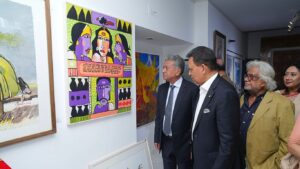

written by: News Desk
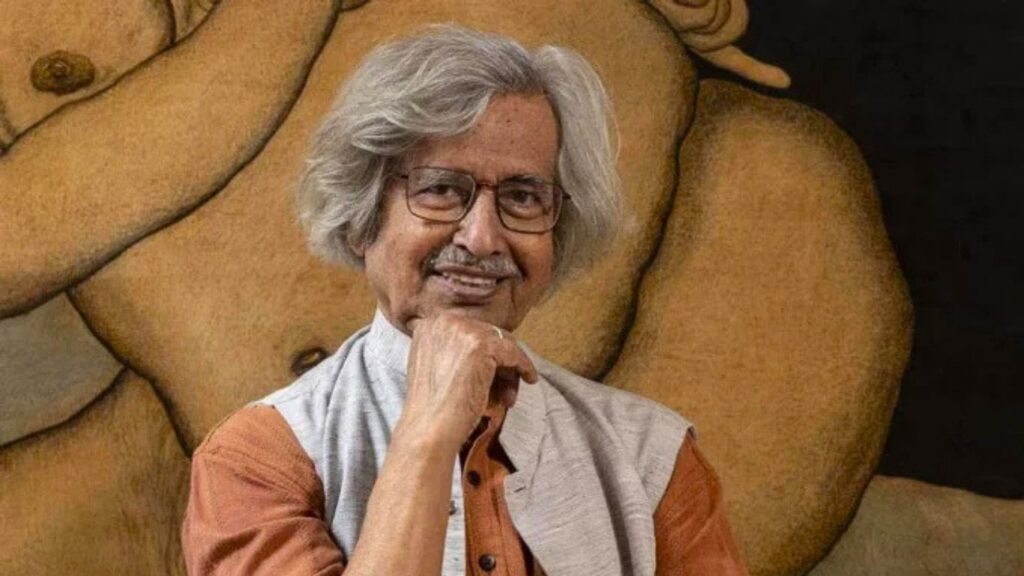
The passing of the Faridpur-born artist marks the end of a remarkable chapter in Indian modern art, leaving behind a profound legacy of expressive line, psychological intensity, and an uncompromising exploration of the human condition.
One of the most influential figures in modern Indian art, Jogen Chowdhury, has passed away at the age of 87. Renowned for his extraordinary command of line, evocative interplay of light and shadow, distorted human figures, and deeply psychological visual language, Chowdhury transformed the representation of the human body into a powerful vehicle for examining society, identity, vulnerability, and the complexities of human existence.
Born in Faridpur, in present-day Bangladesh, Chowdhury died on Sunday, 25 October 2026, at a private hospital in Kolkata following a prolonged battle with a rare form of blood cancer. His death marks the end of an extraordinary artistic journey that helped shape the visual vocabulary of post-Independence Indian art.
According to Indian media reports and hospital authorities, the artist had been suffering from myeloproliferative neoplasm, a rare group of blood cancers, for approximately fourteen months. He had been undergoing regular chemotherapy.
Following a deterioration in his health, he was admitted to Ruby General Hospital in South Kolkata on 16 October. His condition subsequently became critical due to complications, including a urinary tract infection and sepsis. Despite intensive medical intervention and ventilatory support, he died at 10:15 a.m. on Sunday.
His passing has prompted widespread mourning across India’s artistic and cultural communities. Fellow artists, writers, students, scholars, and admirers have paid tribute to a figure whose remarkable creative journey extended far beyond the boundaries of painting.
For generations of artists and art historians, Chowdhury represented a distinctive sensibility within Indian modernism—one that brought together the visual traditions of Bengal, the formal innovations of European modern art, and an intensely personal response to the social and political realities of his time.
Jogen Chowdhury was born on 16 February 1939 in Daharpara village in the Faridpur district of undivided Bengal, now part of Bangladesh.
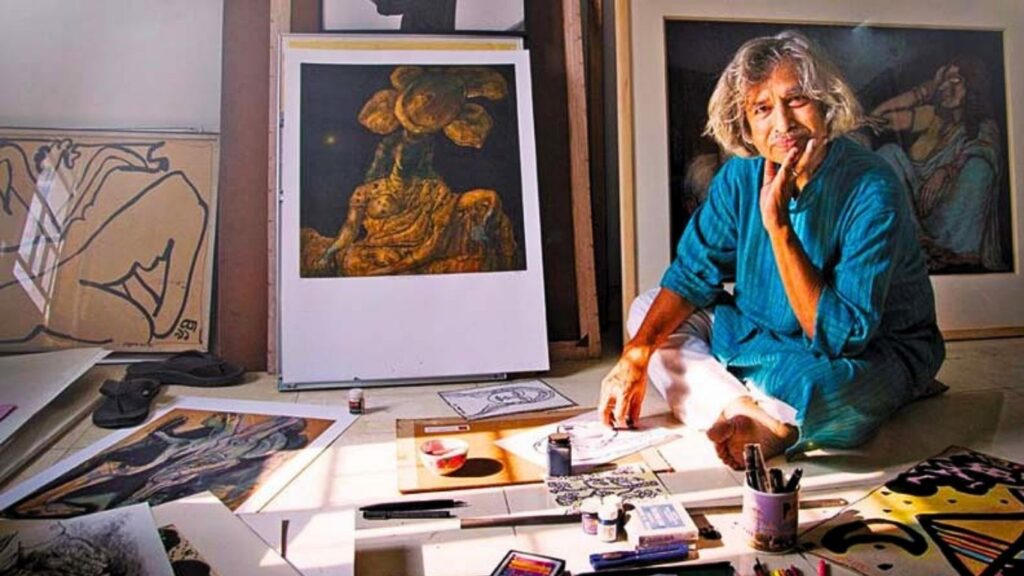
His early childhood unfolded in a culturally rich household where artistic expression was woven into everyday life. His father, Pramathanath Chowdhury, had a deep appreciation for art, while his mother, Indu Devi, was skilled in traditional decorative painting, particularly alpana, the ritual and ornamental floor designs associated with Bengali cultural traditions.
These early encounters with indigenous artistic practices played a formative role in shaping his visual imagination.
The rhythmic movement of decorative lines, the expressive simplicity of folk imagery, the visual character of rural Bengal, and the intimate relationship between art and domestic life gradually became embedded in his artistic consciousness.
In 1948, following the Partition of the Indian subcontinent, Chowdhury moved with his family to Kolkata.
The experience of leaving his birthplace and adapting to an unfamiliar urban environment left a lasting impression on both his personal life and artistic sensibility.
Art critics have frequently identified echoes of displacement, uncertainty, alienation, and psychological vulnerability in his later representations of the human figure.
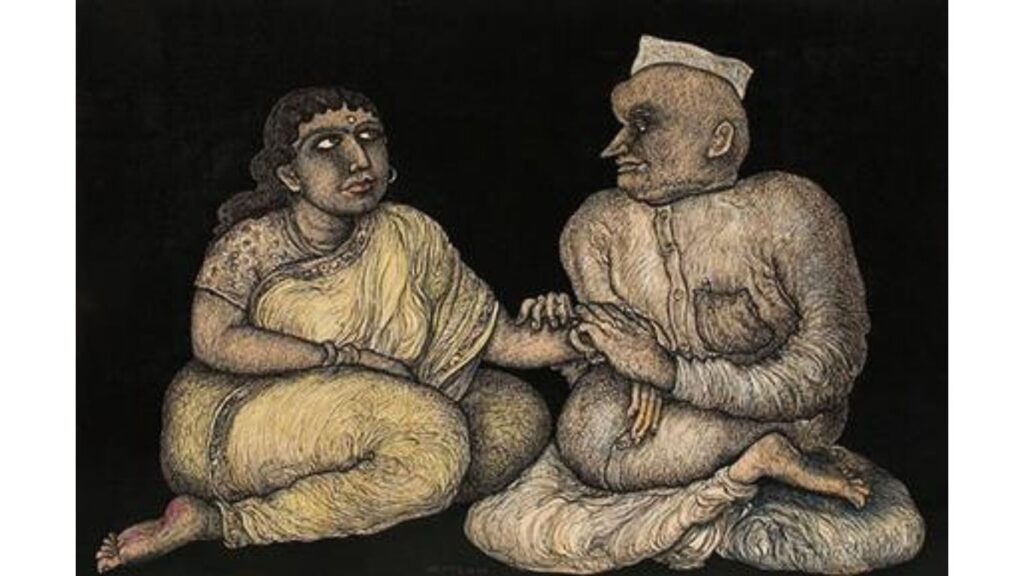
Although his paintings cannot be reduced to a direct visual account of Partition, the experience of migration provides an important historical and emotional context for understanding his persistent engagement with the fragility of human existence.
In 1955, Chowdhury enrolled at the Government College of Art and Craft in Kolkata, where he completed his formal artistic education in 1960.
During these formative years, he began exploring the expressive possibilities of drawing and painting while gradually developing a visual vocabulary that would eventually distinguish him from many of his contemporaries.
Following his graduation, he began his professional career as an art teacher at Howrah District School. He subsequently worked as a textile designer with the All India Handloom Board.
These early professional experiences helped deepen his understanding of decorative structures, surface patterns, and the expressive potential of line—elements that would later become central to his mature artistic practice.
A decisive turning point came in 1965, when Chowdhury received a French government scholarship to pursue advanced artistic studies in Paris.
He studied at the prestigious École Nationale Supérieure des Beaux-Arts, where he encountered a wide range of European artistic traditions, modernist experiments, and new approaches to representing the human body.
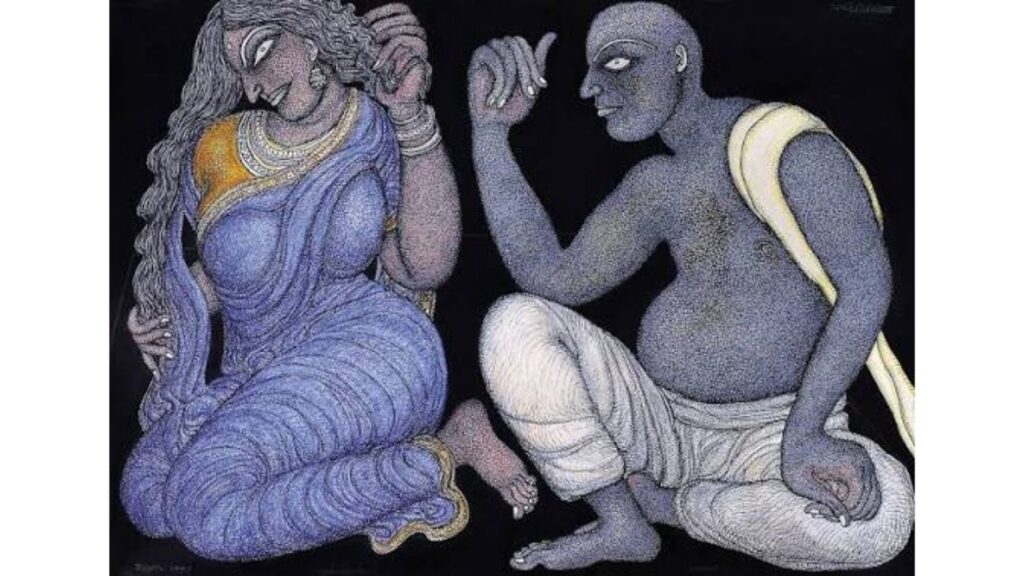
His exposure to European modernism, particularly its expressive distortions, psychological intensity, and formal experimentation, significantly expanded his artistic horizons.
Yet Chowdhury did not simply adopt Western artistic conventions.
Instead, he sought to develop an independent visual language that could accommodate the cultural memory of Bengal while engaging with the broader possibilities of modern artistic expression.
This negotiation between indigenous traditions and international modernism became one of the defining characteristics of his work.
Rather than treating tradition and modernity as opposing forces, Chowdhury brought them into a productive dialogue, creating images that were at once deeply rooted in South Asian experience and unmistakably contemporary.
His artistic development reflected a larger question confronting many postcolonial artists: how to construct a modern visual identity without abandoning the cultural and historical experiences from which that identity emerged.
For Chowdhury, the answer lay not in stylistic imitation but in transforming inherited visual forms into a distinctly personal artistic language.
Perhaps the most immediately recognisable feature of Jogen Chowdhury’s art is his extraordinary use of line.
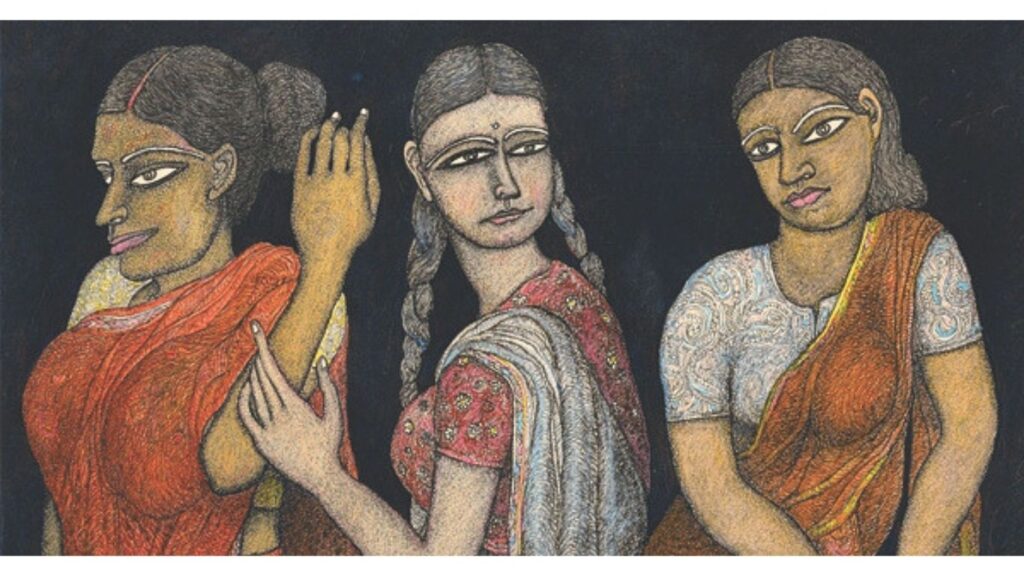
Throughout his career, he explored the expressive possibilities of ink, pastel, watercolour, and other media, developing a distinctive approach in which line functioned not merely as a means of defining form but as an instrument of psychological and emotional revelation.
His celebrated technique of cross-hatching became particularly significant.
Through intricate networks of intersecting lines, he created remarkable variations of texture, tonal depth, volume, and shadow.
The densely layered marks often seem to animate the surface of the human body, transforming skin into a complex terrain of tension, vulnerability, and emotional experience.
In his paintings and drawings, the body rarely conforms to conventional ideals of anatomical proportion or classical beauty.
Figures appear swollen, compressed, twisted, elongated, or otherwise distorted.
Yet these distortions are never merely formal experiments.
They serve as expressive devices through which Chowdhury investigates the psychological pressures, social contradictions, and existential anxieties that shape human life.
His figures frequently occupy dark or nearly empty backgrounds, intensifying their isolation and drawing attention to the expressive possibilities of posture, gesture, and bodily presence.
Faces, limbs, and torsos become charged with an unsettling emotional intensity.
A seemingly ordinary figure may communicate exhaustion, desire, anxiety, humiliation, or silent resistance through the slightest alteration of form.
In this sense, Chowdhury’s treatment of the human body extends far beyond physical representation.
The body becomes a symbolic and psychological space in which questions of power, identity, sexuality, social hierarchy, and human vulnerability intersect.
His images often resist easy interpretation.
They can appear intimate yet disturbing, humorous yet deeply melancholic, familiar yet strangely alien.
This ambiguity is central to their expressive power.
Rather than offering idealised representations of humanity, Chowdhury presents the body as a site of contradiction—capable of embodying both dignity and degradation, desire and despair, resilience and vulnerability.
Through this approach, he established one of the most distinctive figurative languages in modern Indian art.
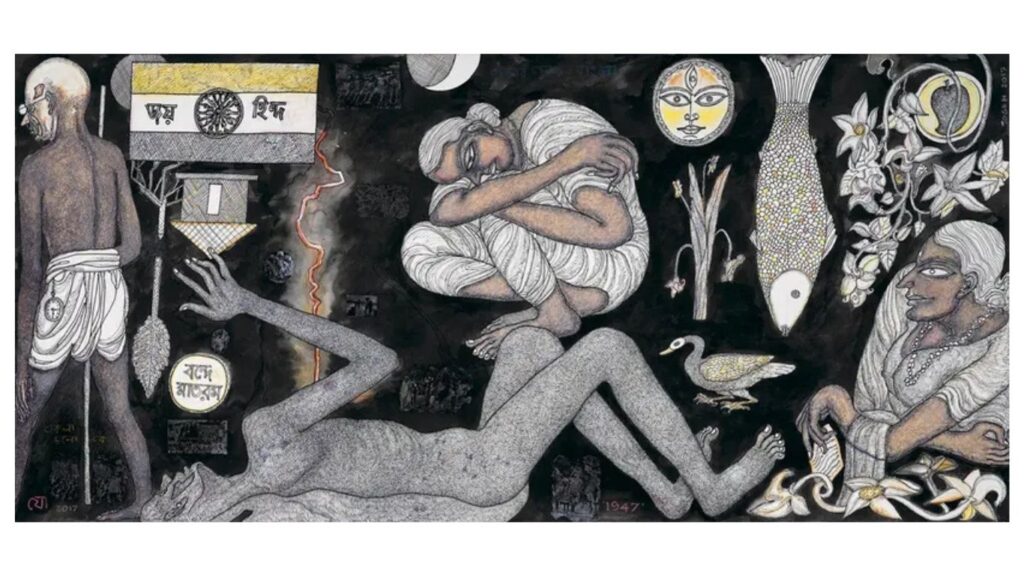
Between Folk Traditions and Modernist Expression
One of the most compelling aspects of Chowdhury’s artistic achievement lies in his ability to bring together apparently divergent visual traditions.
The decorative rhythms of Bengali alpana, the narrative character of folk painting, the linear vitality of patachitra, and the expressive possibilities of European modernism all contributed to the formation of his artistic vocabulary.
Yet these influences rarely appear as direct quotations.
Instead, they are absorbed, reinterpreted, and transformed through a highly individual process of artistic invention.
His paintings reveal a persistent concern with the relationship between external appearance and internal experience.
The visible body becomes a means of suggesting invisible emotional and social realities.
This is particularly evident in his representations of men and women whose exaggerated physical forms seem to register the pressures of their surrounding world.
Their bodies carry traces of social inequality, political instability, desire, vulnerability, and psychological conflict.
Although colour remains an important component of his work, it is often the expressive force of line that determines the emotional character of an image.
Restrained palettes, concentrated shadows, and carefully articulated contours create an atmosphere in which physical form and psychological meaning become inseparable.
His work challenges the conventional distinction between beauty and distortion.
What might initially appear grotesque gradually reveals a deeper emotional truth.
In this respect, Chowdhury’s art is not simply concerned with the visual representation of the human figure. It is equally concerned with the conditions under which human beings experience their bodies, their relationships, and their place within society.
His paintings invite viewers to look beyond physical appearances and confront the anxieties, contradictions, and vulnerabilities embedded in everyday existence.
This capacity to transform the familiar human body into a complex psychological and social metaphor remains among his most significant contributions to contemporary figurative art.
Artist, Educator, and Cultural Thinker
Following his return from Paris, Chowdhury became increasingly involved with major artistic and cultural institutions in India.
From 1972 to 1987, he served as Keeper of Art at Rashtrapati Bhavan, the official residence of the President of India in New Delhi.
The position brought him into close contact with significant artistic collections and provided valuable experience in the preservation, documentation, and presentation of works of art.
His engagement with institutional collections also broadened his understanding of the relationship between artistic production, cultural heritage, and public institutions.
In 1987, Chowdhury joined Kala Bhavana, the renowned art faculty of Visva-Bharati University in Santiniketan, as a teacher of painting.
Santiniketan, with its distinctive intellectual and artistic heritage, became an important centre of his professional and creative life.
Through decades of teaching, he influenced numerous younger artists, encouraging experimentation, independent thinking, and the development of individual artistic identities.
He was subsequently recognised as Professor Emeritus at Kala Bhavana.
His contribution to art education extended beyond the transmission of technical skills.
As a teacher and mentor, he encouraged students to approach artistic practice as an intellectual and cultural inquiry, grounded in personal experience while remaining open to broader historical and social questions.
The environment of Santiniketan, shaped by the educational and cultural philosophy of Rabindranath Tagore, offered a particularly meaningful setting for this approach.
For Chowdhury, artistic practice was never entirely separate from the responsibilities of education, cultural preservation, and critical engagement with society.
His influence therefore extended beyond his own paintings and drawings into the wider intellectual and institutional landscape of Indian art.
International Recognition and Artistic Achievements
Over the course of his distinguished career, Jogen Chowdhury’s works were exhibited extensively in India and internationally.
His paintings and drawings reached audiences in Paris, London, Japan, the United States, and numerous other artistic centres, establishing his reputation within the broader discourse of modern and contemporary art.
His participation in international exhibitions contributed to a growing recognition of Indian modernism beyond the conventional narratives of Western art history.
In 1966, he received the Prix de la Jeune Peinture in Paris, an early acknowledgement of his artistic promise.
His work also received recognition at the Havana Biennial in Cuba in 1986.
In 2001, he was honoured with the prestigious Kalidas Samman by the Government of Madhya Pradesh in recognition of his contribution to Indian art.
The Government of West Bengal subsequently conferred upon him the Banga Bibhushan award in 2012.
His works have entered important institutional and private collections, reflecting their enduring significance within the history of modern South Asian art.
Yet the importance of Chowdhury’s achievement cannot be measured solely through exhibitions, awards, or institutional recognition.
His most lasting contribution lies in the creation of a visual language that continues to challenge established ideas about figuration, beauty, psychological expression, and the social function of art.
Beyond the Studio: Art and Public Life
Although painting remained at the centre of his identity, Chowdhury also maintained an active presence in public and political life.
In 2014, he was elected to the Rajya Sabha, the upper house of the Indian Parliament, as a representative of the All India Trinamool Congress from West Bengal.
He served as a member of Parliament until 2020.
His involvement in politics reflected an engagement with public affairs that existed alongside his longstanding commitment to artistic and cultural institutions.
Nevertheless, his primary identity remained that of an artist, educator, and cultural organiser.
Throughout his career, he advocated for the development of artistic practice, the strengthening of art education, and the wider recognition of artists within society.
His life demonstrated that artistic engagement need not remain confined to the studio or exhibition space.
For Chowdhury, art was part of a broader cultural conversation involving education, institutions, social responsibility, and public life.
Charubasona: Preserving an Artistic Legacy
Among the significant initiatives associated with Chowdhury’s later career was the establishment of Charubasona, an art centre and museum in Kolkata, in 2019.
Conceived as a space for preserving, presenting, and studying his artistic achievements, Charubasona houses works representing different periods of his long creative journey.
Beyond functioning as a repository of his personal artistic legacy, the institution was envisioned as a centre for artistic exchange, research, exhibitions, and cultural discussion.
Its significance extends beyond the preservation of individual works.
By bringing together artworks, archival materials, and opportunities for critical engagement, Charubasona offers a framework through which future generations may encounter and reinterpret Chowdhury’s contribution to Indian modernism.
Following his death, the institution may assume an increasingly important role in safeguarding his artistic heritage and facilitating scholarly research into his life and work.
In this respect, Charubasona represents not simply a memorial to an individual artist but a continuing space for dialogue between artistic history and contemporary cultural practice.
A Legacy Written in Lines
The death of Jogen Chowdhury represents a profound loss to the artistic world of India and the wider South Asian region.
Yet his artistic legacy remains extraordinarily rich.
Across more than six decades of creative practice, he developed a language of figuration that transformed the human body into a powerful site of psychological, social, and existential inquiry.
His achievement lies not merely in the technical mastery of line or the invention of a recognisable style, but in his ability to make the human figure speak about the contradictions of its historical moment.
Born in Faridpur and shaped by the cultural experiences of both Bengal and India, Chowdhury occupied a distinctive position within the shared artistic history of the subcontinent.
The memory of Partition, the visual traditions of rural Bengal, the intellectual influence of European modernism, and the political and social realities of contemporary India converged in his work to produce a visual language of remarkable originality.
His artistic journey also challenges rigid national boundaries in the interpretation of South Asian art.
Although his professional career unfolded primarily in India, his formative experiences in what is now Bangladesh remained part of the cultural inheritance that informed his imagination.
In this sense, his work belongs to a larger history of Bengali artistic modernity—a history shaped by migration, cultural exchange, historical rupture, and creative transformation.
For art historians and critics, Chowdhury’s contribution will continue to invite new interpretations, particularly concerning the relationship between bodily distortion and psychological expression, the transformation of indigenous visual traditions, and the representation of social experience through figurative art.
For younger artists, his career offers an enduring example of how a deeply personal artistic vocabulary can emerge from sustained engagement with history, tradition, and contemporary life.
Above all, Jogen Chowdhury will be remembered as an artist who understood that a line could communicate far more than the visible boundary of a form.
In his hands, lines became instruments of memory, desire, anxiety, resistance, and human vulnerability.
Through the expressive distortions of the body, he revealed the invisible tensions that shape individual and collective existence.
His physical presence may have come to an end, but the extraordinary visual world he created continues to speak.
The master of lines is gone; the language he invented remains—etched into the history of modern art and into the enduring complexities of the human condition.