
written by: News Desk
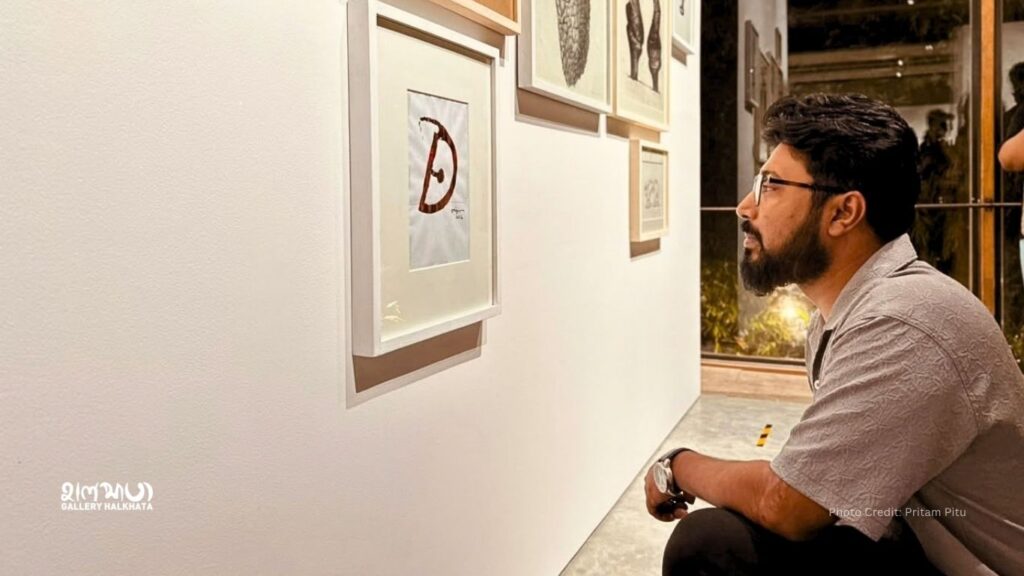
The line is one of the most fundamental languages of art. It can define the boundaries of the visible world, or move beyond them into the realms of emotion, memory and imagination. In the hands of an artist, the line is more than a means of constructing form; it becomes an independent medium for the expansion of thought, the translation of experience and the expression of the self. Exploring these multiple dimensions and possibilities, the group exhibition Unbroken Line has opened at Bengal Shilpalay in Dhaka.
Bringing together seven decades of modern and contemporary art practice in Bangladesh, the exhibition offers an opportunity to revisit the history, evolution and visual language of drawing. Here, the line appears in different roles: as a direct interpretation of reality, a vehicle for abstract expression, and a visible trace of the tensions embedded in time and society.
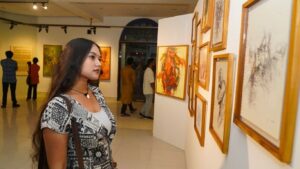
Organised by Bengal Foundation, the exhibition opened on 9 October and features works by 42 artists from different generations. It is being held on the first floor of Bengal Shilpalay, in the Kamrul Hasan Exhibition Hall in Dhanmondi, and will remain open until 30 October.
The exhibition was inaugurated by art critic and writer Moinuddin Khaled and Professor Shishir Bhattacharjee, Dean of the Faculty of Design and Technology at Shanto-Mariam University of Creative Technology. Professor A. K. M. Maynul Islam of the Department of Ceramics and Sculpture at the University of Rajshahi and artist Soma Surovi Jannat attended as special guests.
In the history of painting, drawing has long been regarded as a preparatory stage in the making of a finished artwork. Lines are essential to establishing an initial composition, shaping forms and determining the proportions of a scene. With the development of modern art, however, drawing has gradually moved beyond this supporting function to establish itself as an autonomous artistic medium.
One of the principal contributions of Unbroken Line is its emphasis on this independent artistic identity.
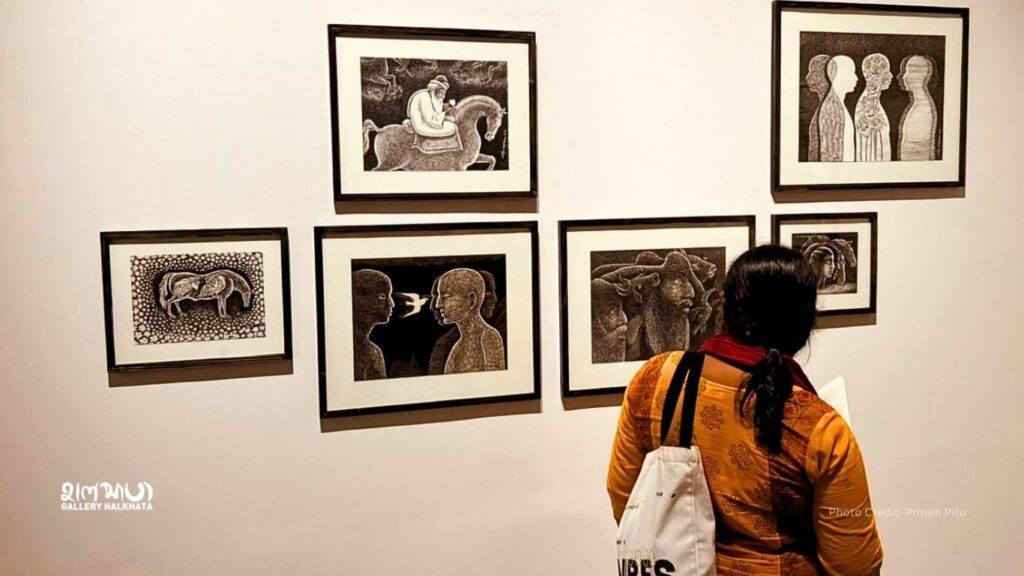
Here, the line is not merely the outline of a visible object; it becomes an element in its own right, capable of generating meaning and emotion. In some works, a few restrained strokes suggest the presence of a human face. Elsewhere, dense layers of black lines create dramatic contrasts between light and shadow. In other works, the irregular movement and arrangement of lines establish rhythms distinctive to abstraction.
The economical use of line in some works evokes a sense of silence and emptiness. By contrast, clusters of dense, rapid and restless strokes suggest movement, tension or inner conflict.
Such variations reveal that the expressive capacity of a line extends far beyond its visible presence. The spaces between lines, as well as their movement, pressure, density and rhythm, are equally important in shaping the meaning of an artwork.
Drawing has played a particularly significant role in the history of modern art in Bangladesh. In the work of Shilpacharya Zainul Abedin, the line became a powerful language for expressing the struggles of human life and the realities of society. In the hands of subsequent generations, it acquired a wider range of aesthetic and conceptual possibilities.
In Zainul’s work, the line captures the structure of the human body, the experiences of working people and the dynamism of everyday life. It does more than define the contours of a figure; it also conveys the conditions of human existence and the experience of struggle.
In Kamrul Hasan’s visual language, by contrast, the line often assumes a rhythmic, lively and ornamental character. The influence of folk-art traditions, the treatment of the human figure and the dynamic organisation of the picture plane contribute to the distinctive quality of his lines.
Safiuddin Ahmed’s practice reveals another dimension of sensitivity to line. Particularly in his printmaking, the precision of the line, structural discipline and interplay of light and shadow lend his work a distinctive visual language.
The artistic approaches of these three pioneers provide an important foundation for understanding the diverse possibilities of drawing in modern Bangladeshi art.
By presenting their works alongside those of later generations, Unbroken Line offers an opportunity to trace the continuing transformation of drawing as an artistic practice.
The exhibition encompasses a broad spectrum of visual languages, from early explorations of modernism to the personal, conceptual and experimental tendencies of contemporary art.
The diversity of subject matter and form encourages viewers to reconsider the expressive possibilities of drawing. Some works present human bodies and faces in simplified forms; others draw on boats, aquatic life or elements of everyday experience. In still others, recognisable forms dissolve into abstract compositions shaped by the relationships between line, shadow and empty space.
These works resist a straightforward division into representational and abstract categories. In many cases, visible reality and the artist’s personal experience merge to generate new meanings.
A line can identify the form of an object, but it can also disrupt that form, opening up space for the viewer’s imagination.
This is one of the fundamental characteristics of drawing. Rather than explaining a scene in its entirety, it can create possibilities for meaning through incompleteness.
Viewers, in turn, do not simply observe the forms created by the artist. They bring their own experiences and imaginations into the spaces between the lines, the pauses and the elements left unspoken.
Another important aspect of the exhibition is the presentation of works by artists from different generations within a shared space.
Alongside artists such as Zainul Abedin, Kamrul Hasan, Safiuddin Ahmed, S. M. Sultan, Murtaja Baseer, Aminul Islam, Qayyum Chowdhury, Rafiqun Nabi, Shahabuddin Ahmed, Kalidas Karmakar, Hamiduzzaman Khan, Jogen Chowdhury, Paritosh Sen and Kazi Abdul Baset, the exhibition includes works by artists from the middle and younger generations.
Other participating artists include Bipasha Hayat, Dhali Al Mamun, Shishir Bhattacharjee, Tayeba Begum Lipi, Mostafa Zaman, Nazneen Ahmed, Farah Naz Moon, Israt Jahan Tanni, Rikel Chakma, Mishkatul Abir, Sinthia Akter Shanta and Syed Zakir Emon, among others.
This breadth of participation makes the exhibition more than a gathering of individual artworks. It creates a visual dialogue between the artistic ideas and modes of expression that have emerged at different points in time.
In the works of senior artists, attention to form, structural discipline and social reality often assumes particular importance. Among younger practitioners, personal experience, conceptual inquiry and experimentation with the limits of the medium also come to the fore.
These differences, however, should not be reduced to a simple generational divide. Experimental impulses were present among early modern artists as well, while many contemporary practitioners continue to engage with traditions of representation and observational drawing.
The exhibition therefore invites viewers to understand art history not as a straightforward account of linear progress, but as a multifaceted process of continuity, change and reassessment.
The history of art in Bangladesh has long been closely connected to institutions and artistic networks centred in the capital. Yet art education institutions outside Dhaka and regional art communities have also developed distinctive visual languages and fields of experience over time.
The inclusion in Unbroken Line of works by artists based in Dhaka, alongside representative and experimental works associated with regional art institutions, is therefore particularly significant.
Geographical location, social experience, cultural environment and differences in artistic education can all shape an artist’s perspective. The expression of these varied experiences within the same medium further expands the possibilities of drawing.
Such participation brings the broader geography of artistic practice in Bangladesh into view while also creating an opportunity to reconsider the conventional distinction between centre and periphery.
One of the distinctive qualities of drawing is its immediacy. The movement of an artist’s hand, the pressure of a stroke, moments of hesitation, confidence or sudden change can often be seen directly in the line.
Without the layers of colour and the range of materials that may mediate other forms of art, drawing can establish an intimate connection between the viewer and the artist’s process of making.
In this sense, a drawing is not simply a finished artwork; it can also serve as a visible record of the movement of thought.
A swiftly drawn line may capture the intensity of an immediate feeling, while slow, measured and repeated strokes can convey prolonged observation and concentration.
These qualities become especially significant when seven decades of artistic practice are viewed together. The lines of artists from different periods reveal not only changes in style, but also shifts in the relationship between artists, society, history and personal experience.
The title Unbroken Line itself suggests a central idea of the exhibition: although the language of art changes, the exploration of the line continues.
Art has repeatedly undergone transformations in its media, technologies and aesthetic ideas. From representation to abstraction, and from personal expression to concept-driven practice, the line has been used in new ways at every stage.
Yet it has not lost its fundamental expressive power. Instead, it has continually reinvented itself in response to changing artistic ideas.
The exhibition at Bengal Shilpalay offers a visible presentation of this ongoing inquiry.
Here, the line becomes, at different moments, a record of history, a trace of personal feeling, a commentary on social reality, or an independent arrangement of form, movement and empty space.
Taken together, Unbroken Line provides an important occasion to reconsider the position of drawing in modern and contemporary Bangladeshi art. The exhibition reminds us that the line is not merely the beginning of art; it can constitute an entire artistic world of its own, in which even a single stroke may carry deep resonances of time, memory and human experience.
Exhibition details
Unbroken Line (অপ্রমেয় রেখা)
Dates: Until 30 October 2026
Venue: Kamrul Hasan Exhibition Hall, first floor, Bengal Shilpalay, House 42, Road 27 (New Road 16), Dhanmondi, Dhaka 1209
Opening hours: Daily, 4:00 pm–8:00 pm
Open to all