
written by: Rezaur Rahman

“If mathematics is seen correctly, it contains not only truth but also a supreme beauty—a beauty as cold and coherent as that of sculpture.” — Bertrand Russell
As old as human civilisation is, so too is the history of art. In humanity’s struggle for survival, the beliefs and ideas through which societies evolved found expression in art. Sometimes it appeared as marks scratched onto the walls of caves; sometimes as figures carved in stone, or forms shaped from wood, clay or rock. Human beings and art, therefore, have always been bound by an inseparable thread—art is an essential part of the human condition.
Sculpture: An Ancient and Enduring Language of Art
Among the oldest and most coherent forms of artistic expression, sculpture holds a distinctive place.

If we trace the origins of human civilisation, art is one of the means through which we have been able to understand its age and history. In contemporary terms, sculpture—or the making of three-dimensional forms—has remained a powerful record of human existence.
Bertrand Russell, the philosopher, mathematician and social critic, found beauty within the rigorous structures of mathematics. Perhaps sculpture offers a similar encounter: something solid, ordered and tangible, yet capable of carrying emotion and meaning.
So, what exactly is sculpture?
Simply put, sculpture is a three-dimensional work of art. In the early history of art, two forms were particularly significant. One was painting, which created images through line, colour, light and shadow. The other was sculpture—a form that could be touched and physically experienced, possessing length, width, height, surface and volume.
Yet beyond these physical qualities lies something more elusive: the ability to breathe life, emotion and aesthetic beauty into materials such as stone, clay, wood, brick, iron and steel.

From the age of the cave to the present day, countless branches of art have emerged, yet sculpture has retained a remarkable sense of modernity. Almost every civilisation has its own history of ancient sculpture, monuments or architectural forms.
The history of sculpture in the Indian subcontinent is equally ancient, deeply intertwined with religious narratives and cultural traditions. Archaeological discoveries in what is now Bangladesh include sculptural remains dating back to the third century BCE. From prehistoric times onward, sculpture has therefore carried a significant part of the history, culture and heritage of this land.

Art Carved in Stone, History Given Form
In Bangladesh, the development of modern sculpture is closely associated with the pioneering work of Novera Ahmed. Although the history of sculpture in the country is much older, institutional sculpture education began relatively recently. In 1964, sculptor Abdur Razzaque played a significant role in establishing formal sculpture education.
A number of artists subsequently carried this tradition forward through their practices. Among them is sculptor Toufiqur Rahman.
After completing his art education in Bangladesh in the 1980s, Rahman went abroad to pursue further studies and successfully completed his artistic training. Returning home, he continued to work consistently across sculpture, installation and other artistic media.

Line, Form and Stillness
Under the title “Line, Form, Stillness,” Toufiqur Rahman presents a body of sculptures and drawings before art lovers.
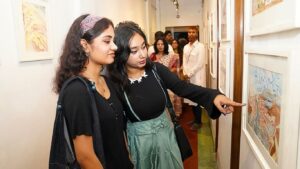
At Kala Kendra, lines and ink acquire a distinct rhythm across the gallery walls, while sculptures occupy the space between them. In keeping with the title of the exhibition, the artist remains firmly grounded in the physicality of his chosen materials.
He works with hard, industrial materials—particularly metal—and transforms his ideas into form by joining one component to another through welding. Iron is inherently rigid; giving it a sense of life is an even more demanding task. Yet this is precisely the challenge the artist continues to embrace.
In sculpture, dimensions are only part of the experience. Surface and smoothness also play important roles, but the welding process does not necessarily seek conventional perfection. Instead, its marks and roughness become part of the visual language.

A Different Rabindranath in Steel
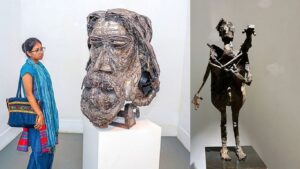
Among the works is the artist’s sculptural interpretation of Rabindranath Tagore, through which he presents an entirely different Tagore to the viewer.
This is not simply a portrait. It is the artist’s own expression of Rabindranath—a figure that seems youthful, radiant and powerful, yet remains deeply still in places.
Burnt and welded metal sheets give form to this solitary Rabindranath. The material appears to have passed through fire before settling into its final shape, carrying traces of transformation within itself.
Rabindranath Tagore, whose creative legacy extends across poetry, literature, music, painting and numerous other forms of artistic expression, seems particularly suited to such a multidimensional interpretation.
Through the interplay of light and shadow, each piece of hardened steel appears to offer a different reading of Rabindranath. The metal no longer remains merely metal. It becomes a vessel for memory, interpretation and emotion.
In Toufiqur Rahman’s hands, steel acquires a heartbeat.
“Sculpture is an art of intelligence.”
The other sculptures in the exhibition evoke different messages and emotions. The steel rooster and goat recall animals that were once an intimate part of traditional household and rural life. Yet within these rigid steel forms, one can almost sense the heartbeat of living creatures.
A striking resemblance can be observed between Toufiq’s “Goat” and Pablo Picasso’s celebrated sculpture “The Goat.” Both evoke the maternal presence of the female goat—the full, rounded udders filled with milk, while a kid waits for the nourishment they hold. The structural treatment of the rooster and goat also carries a subtle echo of Picasso’s Cubist forms.
Toufiq transforms the structure of the human body through the forms of nature, while preserving an underlying sense of life and rhythm. He brings together two seemingly different worlds—the everyday lives of ordinary people and the wild flowers, vines and foliage of nature. Through their encounter, he gives birth to a new vitality within the hard, unforgiving surface of steel.

The artist’s deep social awareness is equally evident throughout the exhibition. His works also reveal a critical attitude toward the structures and layers of capitalism embedded within society. The human body—particularly the body as a site of struggle—appears repeatedly, accompanied by defiant hands that seem at times immersed in nature and at other times trapped within conflicts created by human society.
“Sculpture is the play of light and shadow; it is essentially a combination of masses and hollows.”— Auguste Rodin
Some of the sculptural forms maintain a subtle affinity with traditional Bengali patterns and decorative motifs. The traces of the artist’s lived experience appear across the gallery walls as countless lines and visual impressions. Through ink drawings, he also conveys an atmosphere of a consciousness striving to free itself from restraint.
Toufiq is not an artist who confines himself within the prescribed boundaries of a gallery’s four walls or its controlled play of light and shadow. His works themselves make that clear. Yet artist Wakilur Rahman has created a compelling arrangement of light and shadow within the exhibition space. This theatrical interplay enters into a quiet dialogue with the hard surfaces of steel and, in turn, with the viewers who come to experience the works.
To describe the artist’s latest exhibition simply as a sculpture exhibition would perhaps be to limit its scope. It may be more fitting to think of it as a “Metamorphosis of Steel.”
Here, steel is sometimes figurative and sometimes abstract; sometimes illuminated by light, and sometimes transformed through the brown patina of rust. What emerges is a new pulse—one that continually moves between presence and absence, solidity and abstraction, permanence and decay.
May this search for new life continue, carrying its contradictions forward through the language of art.
Rezaur Rahman
Artist and Writer