
written by: News Desk
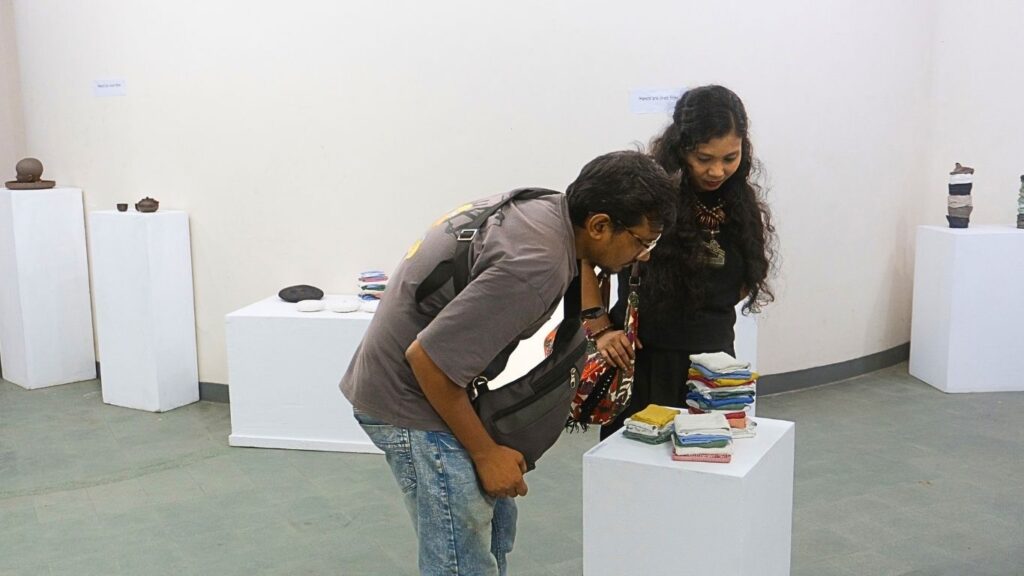
Through clay, worn fabric and fire, ceramic artist Md. Anisul Haque explores human suffering, inequality, oppression and the fragile condition of existence.
Clay is more than the earth’s material surface. Its relationship with human civilisation is ancient and intimate. From settlement and everyday life to construction and creative practice, clay has remained closely connected to human experience. Once shaped and transformed by fire, it becomes something more enduring—a material record of memory, emotion and time.
This idea lies at the heart of Md. Anisul Haque’s third solo exhibition, The Journey of Material, Form and Fire: From Clay to Ceramic, currently on view at Zainul Gallery, Faculty of Fine Arts, University of Dhaka. The exhibition continues until 22 September, open daily from 11am to 7pm.
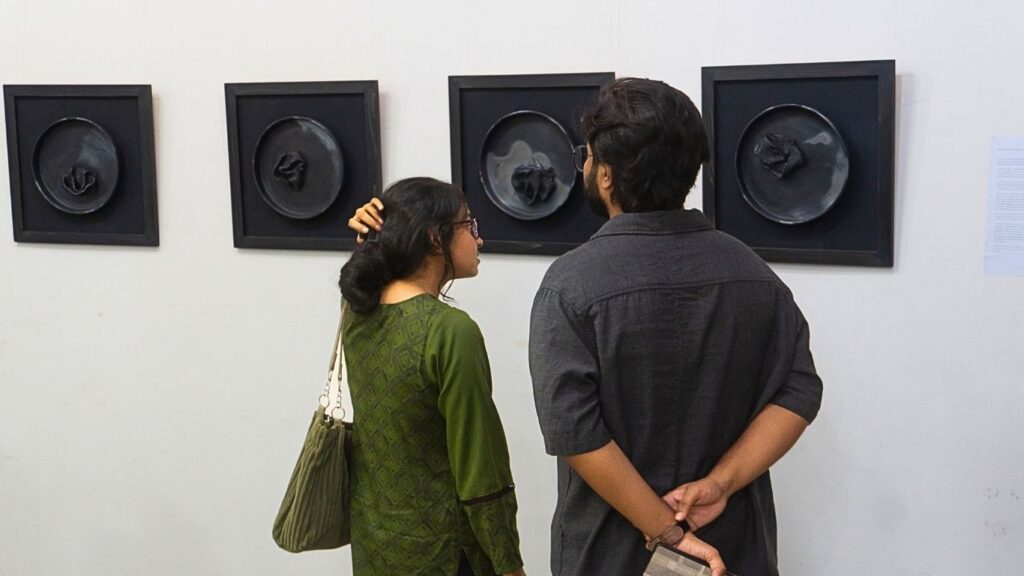
One of the defining features of Haque’s practice is his experimentation with materials. Moving away from the polished surfaces traditionally associated with ceramics, he incorporates old and worn fabric into clay, creating rough, uneven and sometimes unsettling surfaces.
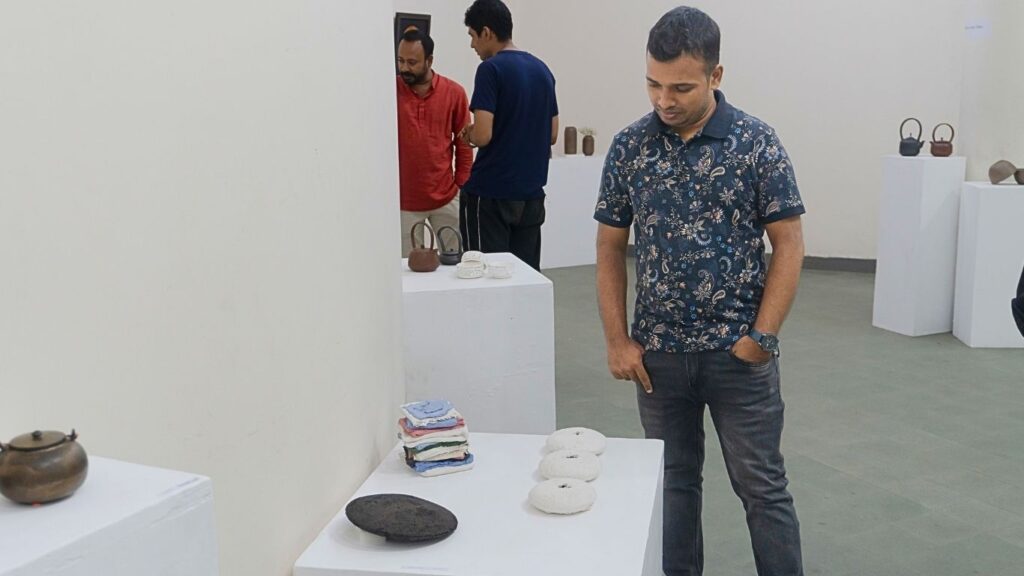
The worn textures are more than formal experiments. They serve as visual metaphors for contemporary crises—racism, oppression, inequality, deprivation and violence against women.
In one work, layers of folded clay resemble a pile of discarded fabric. Seen from a distance, the forms appear almost abandoned and unusable; up close, they suggest accumulated pain and the silent weight of marginalised lives.
Elsewhere, a rough fabric-like binding across a blue-green surface evokes a tension between confinement and freedom. Here, material itself becomes a vehicle for the idea.
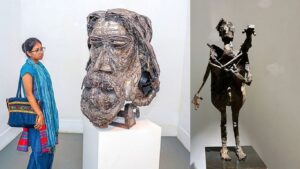
Haque’s figurative sculptures similarly move beyond physical representation. The human body becomes a vessel for psychological and social wounds.
In one standing female figure, a rough, perforated texture envelops the body like worn fabric. There is little sense of conventional expression in the face; instead, the figure conveys emptiness, exhaustion and a quiet resistance.
The work does not refer to a particular event or geography, yet it can be read in relation to the experiences of people living through war, violence, displacement and oppression across the world.
Haque describes his sculptures as a “versatile mirror”—a space where contemporary realities can be reflected alongside the viewer’s own experiences and interpretations.
The exhibition, however, is not confined to conceptual sculpture. Haque also presents a range of utilitarian ceramics, including juice sets, teapots and cups, demonstrating how everyday objects can acquire an independent aesthetic presence.
His control over form, proportion and surface is evident throughout these works. Elongated jugs with smooth brown surfaces and cups of varying heights possess a restrained contemporary elegance.
A black, matte-finished teapot combines geometric patterns with a curved handle, giving the functional object an almost sculptural character. Another teapot set, finished with a metallic glaze, recalls the visual richness of aged bronze or copper.
A green vessel decorated with a fish motif brings another dimension to the collection, connecting contemporary ceramic form with the visual memory of local folk art.
The significance of Haque’s exhibition lies in the way he connects material with ideas. For him, ceramics is not merely a medium of making; it is a way of thinking about the realities of the contemporary world.
Questions of identity, inequality, oppression and human coexistence run through the works. The exhibition therefore extends beyond technical or formal explorations of ceramics, asking how clay can become a language for social and human experience.
For Haque, art is a meaningful act capable of carrying a powerful message and leaving an impact on society. His humanist outlook places the idea of shared humanity above divisions of religion, nationality or geography.
In this context, clay, worn fabric and fire become more than materials. They carry the weight of contemporary life—its fractures, conflicts, memories and possibilities.
At Zainul Gallery, Haque’s works suggest that clay is never merely clay. Once shaped and fired, it can hold traces of human history, suffering, resistance and the desire to survive.
Ultimately, The Journey of Material, Form and Fire is not simply a journey from clay to ceramic. It is a movement from material to meaning, from form to feeling, and from artistic practice towards a deeper reflection on humanity.

Great ,thank you so much