
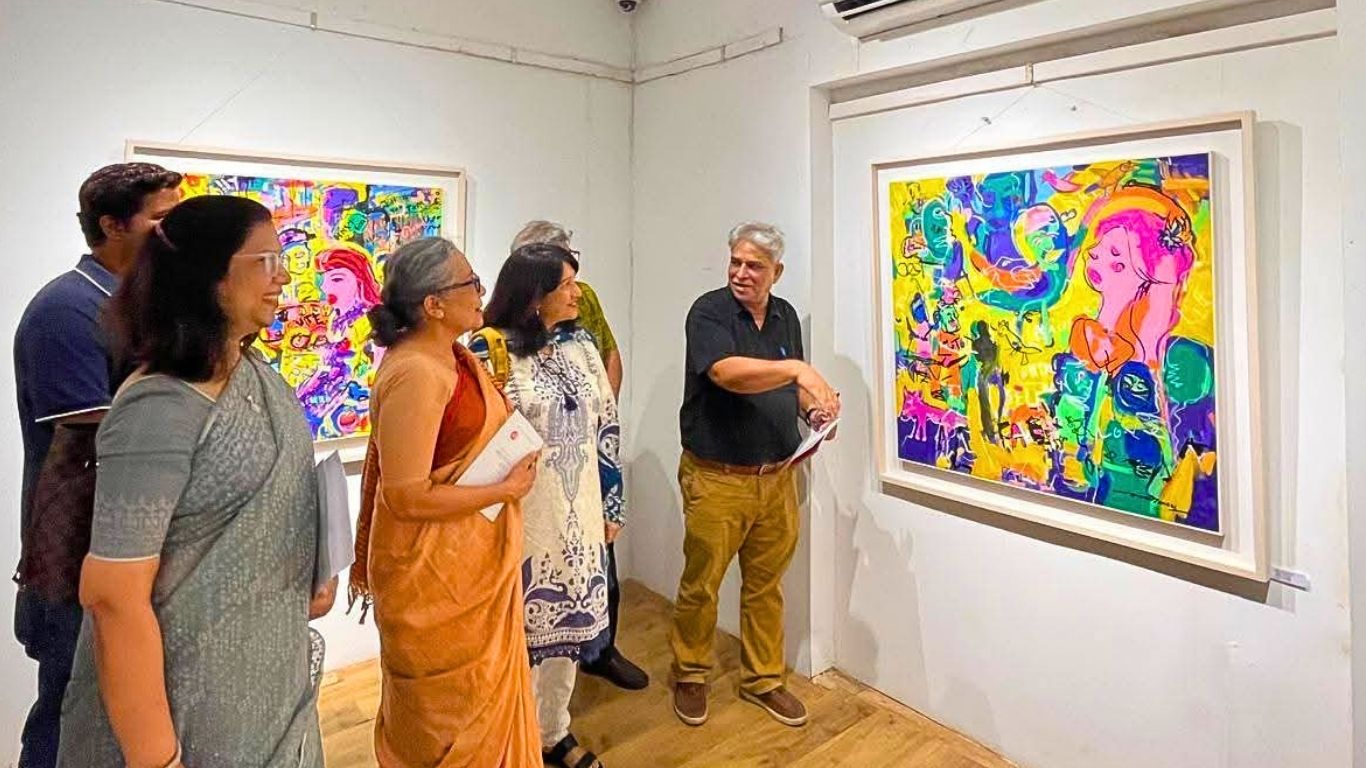
Humanity does not speak through a single visual language. At times, it emerges through the human face and body; at others, through nature, animals, colour, line, light and shadow, or through abstract forms and symbols. It is within this multiplicity of human experience that ArtNest, an independent contemporary art organisation, has formally begun its journey with its inaugural group exhibition, Humanity and Hope.
Bringing together the works of nine contemporary artists, the exhibition explores different dimensions of humanity, empathy, coexistence, struggle and hope through diverse artistic approaches.
The exhibition opened on 20 August at The Illusions Gallery in Lalmatia, Dhaka, and will remain open to visitors until 25 August, from 3:00 PM to 10:00 PM daily.
A Multitude of Artistic Voices
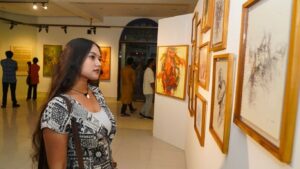
One of the defining features of Humanity and Hope is the diversity of its visual languages. Although the participating artists engage with a shared humanistic premise, each approaches it through a distinct vocabulary of colour, line, form and composition. The result is a visual dialogue rather than a singular aesthetic statement.
In some works, human figures and faces become vehicles for emotion and introspection. Elsewhere, birds, animals, leaves and elements of nature suggest the interconnectedness between human existence and the wider living world. Some works rely on delicate lines, restrained tones and monochromatic compositions to create a sense of quiet contemplation.
In contrast, vivid shades of yellow, red, blue and purple bring energy and emotional intensity to other works. Through these varied approaches, the artists explore different facets of human experience, desire and existence.
Several works employ shades of grey and black to construct relationships between animals, natural forms and their surrounding environments. Elsewhere, a meditative image of Gautama Buddha, rendered through black-and-white lines alongside lotus flowers and foliage, creates an atmosphere of serenity and introspection. Here, line functions not merely as a means of representation but also as a visual language of stillness and contemplation.
Nine Artists, Nine Visual Languages
The exhibition features Rashid Amin, Saifuddin Mahbub Ahmed, Fahmida Enam Kakoli, A. H. Dhali Tomal, Golam Faruk Swapan, Tarek Amin, Saurav Chowdhury, Manzur Rashid and Naim Zaman.
Their works differ in subject matter, colour treatment, line, composition and modes of construction. While some explore emotion through the human figure and facial expression, others turn towards nature and the animal world as symbolic elements. Some move beyond recognisable forms, using colour and line as independent expressive devices.
This diversity allows the exhibition to avoid presenting a single definition of humanity. Instead, each artwork creates its own interpretive space, allowing viewers to engage with the works through their individual experiences, memories and emotions.
When Art Becomes a Social Dialogue
The opening programme also emphasised the importance of taking art beyond the gallery walls and connecting it with wider social and cultural life.
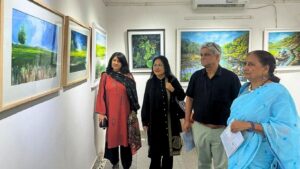
The event was attended by Luva Nahid Choudhury, Director General of Bengal Foundation; art critic Moinuddin Khaled; and Nahid Mahtab, Commissioner of the Bangladesh Securities and Exchange Commission (BSEC) as special guests. Participating artist Rashid Amin also spoke at the event.
Art critic Moinuddin Khaled discussed the exhibited works in relation to their themes, colours, lines, concepts and modes of execution, highlighting the individual artistic languages and creative processes of the nine participating artists.
Nahid Mahtab emphasised the importance of strengthening communication between artists and audiences, as well as preserving records and archives of artistic practices. Rashid Amin, meanwhile, spoke about the need to make artworks accessible to a broader public. From his perspective, art should not remain confined to the gallery space; it should also find a place within people’s everyday lives and personal environments.
Beyond the Exhibition
Although Humanity and Hope marks ArtNest’s first exhibition, the organisation’s vision extends well beyond a single presentation. It aims to create an active platform for the development of contemporary visual art through exhibitions, research, workshops, artist-audience dialogue and international cultural exchange.
According to Naim Zaman, founder and director of ArtNest, the organisation plans to undertake a range of initiatives, including artist talks, documentary production, archiving, and documenting the lives and practices of artists. Online exhibitions are also part of its vision to bring contemporary art to a wider audience.
Beginning with the guiding philosophy “Inspiring Humanity Through Art,” ArtNest’s first exhibition raises a broader question: how can contemporary art nurture a deeper sense of humanity within society?
The answer does not lie in any single artwork, but in the collective presence of nine distinct artistic voices. Human faces, natural forms, animal figures, vibrant colours, delicate lines and contemplative monochromes come together to evoke different resonances of human existence.
In this sense, Humanity and Hope is not simply ArtNest’s inaugural exhibition; it is a pluralistic artistic inquiry into humanity itself—an invitation to look at the human condition through the diverse languages of contemporary art.