
written by: Bappy Linkon Roy
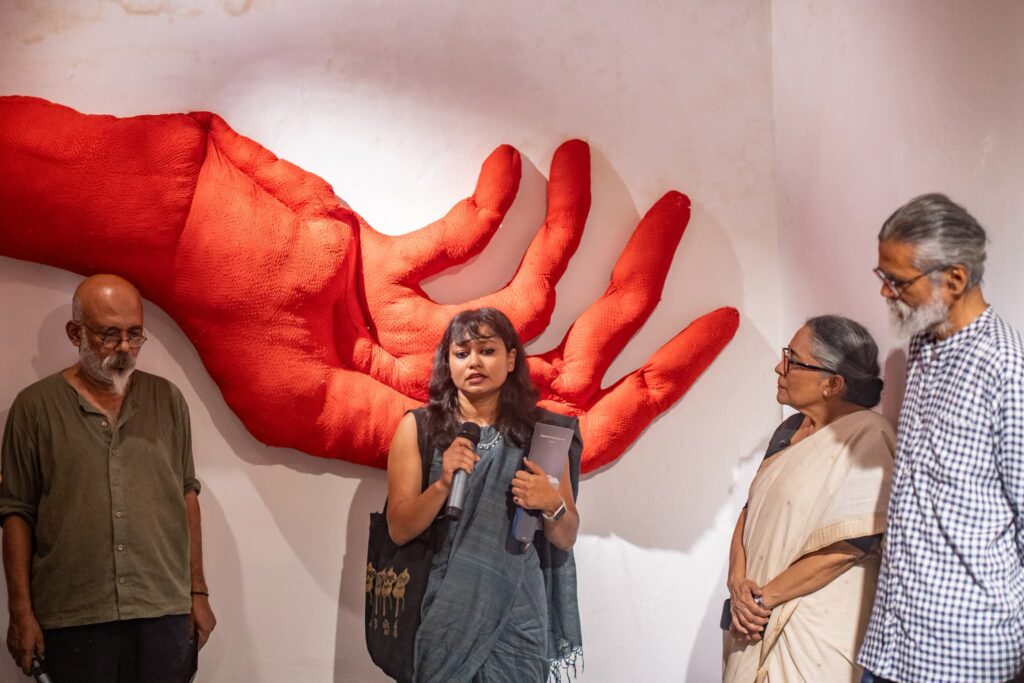
Motherhood has long been a subject in contemporary art, yet relatively few artists explore it as a process of bodily reconstruction, the rewriting of identity, and the politics of invisible labour. In her solo exhibition Fragmented yet Tangled: Living Within 2, artist Bubly Barna presents this complex experience through a compelling textile-based visual language. Held at Kalakendra in Lalmatia, the exhibition is far more than a collection of artworks—it offers a quiet yet powerful space for rethinking the body, memory, and identity of women.
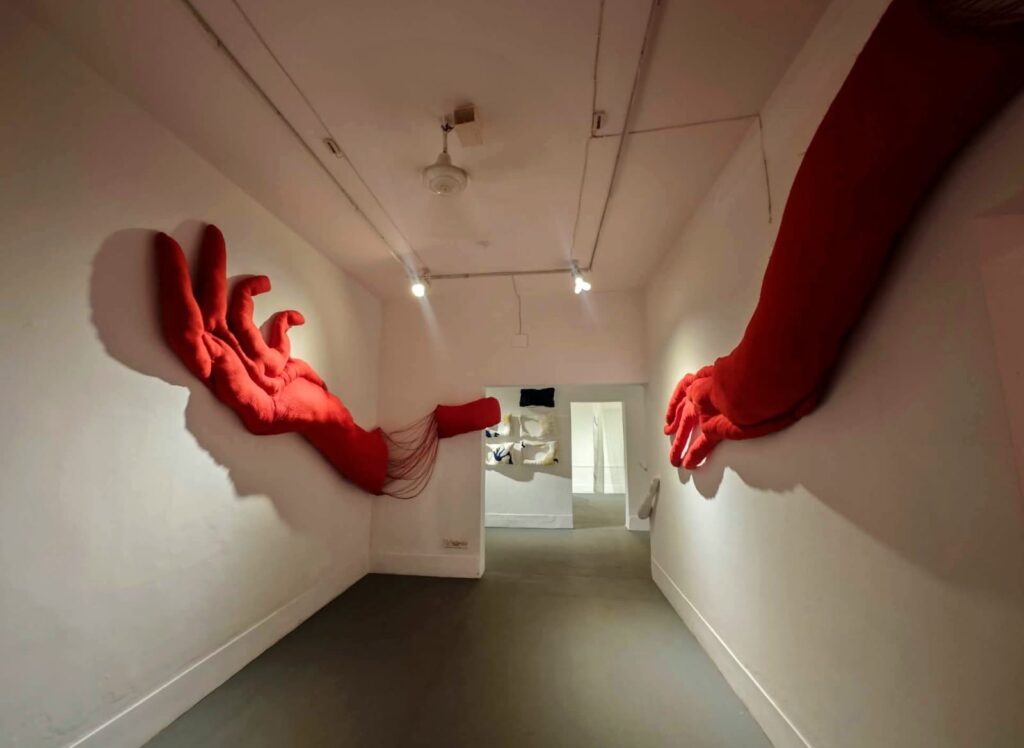
From the moment visitors enter the exhibition, it becomes evident that the artist has no intention of presenting the body as a complete or unified form. Instead, she fragments it into hands, legs, torsos, knees, and carefully stitched body parts. This fragmentation is not a record of violence; rather, it serves as a visual metaphor for the transformation of identity. Just as motherhood reshapes a woman’s body, it also reconfigures her sense of self. Bubly Barna captures this transformation through disjointed forms instead of a singular, complete body.
One of the exhibition’s most significant installations, Who is Going to Cook in Heaven?, immediately confronts viewers with an unsettling question. Human figures stitched onto translucent fabric sway gently in the air, blurring the boundary between visibility and invisibility. Here, cooking is not merely a domestic activity but a cultural metaphor for women’s invisible labour, social expectations, and deeply rooted gender roles. The artist asks whether a woman’s identity is still confined within the responsibilities of domestic life.
One of the most remarkable aspects of Bubly Barna’s practice is her choice of materials. Fabric, quilting, stitching, and everyday household objects are employed not simply as aesthetic elements but as vessels of memory and lived experience. The traces of time embedded in cloth, the touch of the body, sleepless nights, and layers of family history acquire new meaning within her work. Textile, therefore, is not an alternative to canvas but a living archive of memory.
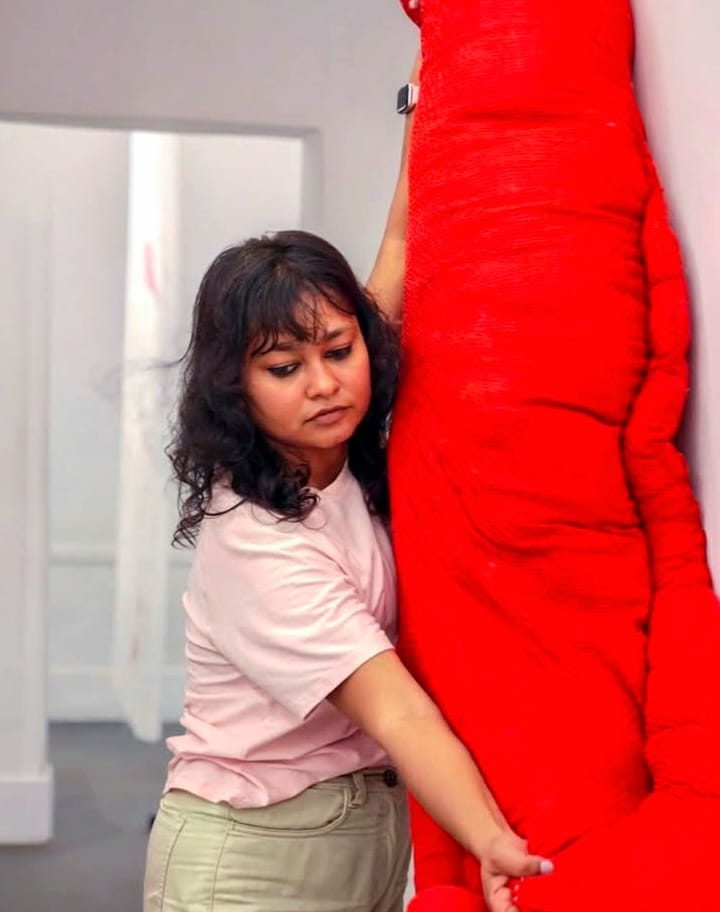
The artwork I Haven’t Slept for a Thousand Nights deepens the emotional dimension of the exhibition. The curled-up female figure becomes a silent sculpture of exhaustion. The aspects of motherhood that are often hidden behind celebratory narratives—endless sleeplessness, physical fatigue, and emotional isolation—are made visible with striking sensitivity. Motherhood is not romanticised here; it is presented as a real, demanding, and profoundly human experience.
Similarly, the Fourth Trimester series thoughtfully explores the period following childbirth. Throughout art history, representations of motherhood have largely centred on the emotional bond between mother and child, while the physical and psychological transformations of the postpartum period have rarely been addressed. Bubly Barna brings this overlooked chapter to the forefront with remarkable sensitivity and insight.
The exhibition is not without its limitations. The conceptual strength of the works is so dominant that the visual diversity occasionally feels restrained. The repeated use of similar colours, materials, and compositional strategies may create a sense of repetition for some viewers. However, this repetition ultimately becomes an integral part of the artist’s visual language, reinforcing the continuity of her conceptual framework.
Overall, Fragmented yet Tangled: Living Within 2 is a significant contribution to contemporary Bangladeshi art. Rather than treating motherhood as a sentimental symbol, the exhibition encourages viewers to understand it as a complex political reality shaped by the body, labour, memory, and identity. Bubly Barna’s work reminds us that a body is never merely a body; within it reside time, relationships, history, and the ever-evolving stories of multiple selves.
The exhibition will remain open to visitors from 4 July to 25 July, daily from 4:00 pm to 8:00 pm.
Venue: Kalakendra, 9/3, Block D, Lalmatia, Dhaka.