
written by: Bappy Linkon Roy
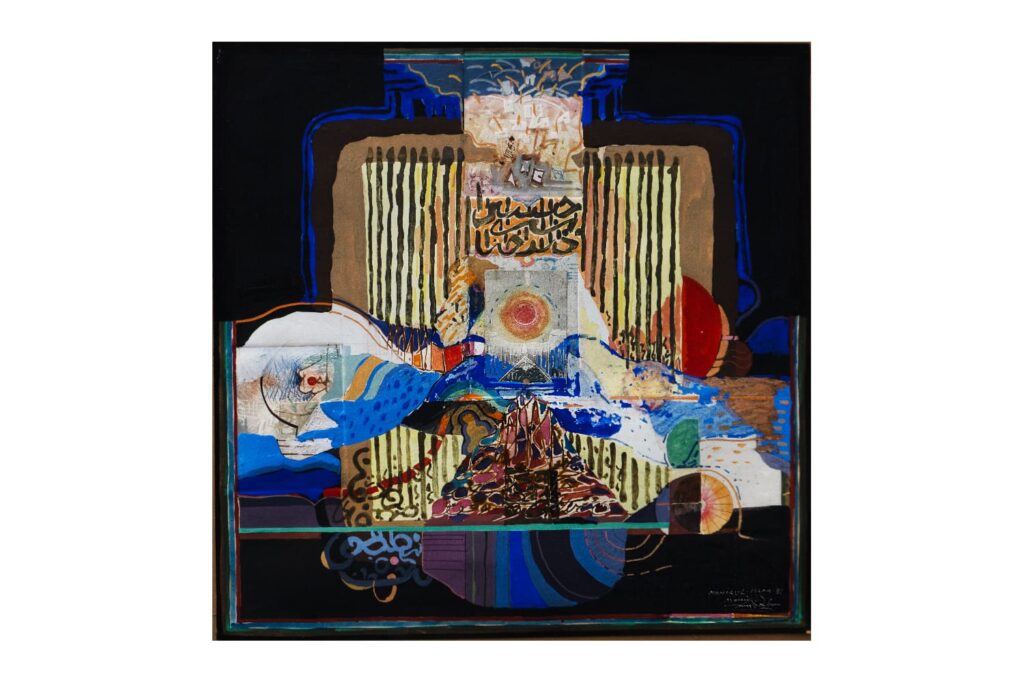
mix media painting, Year: 1981
As a critical theory in art, Formalism emphasizes the primacy of visual and structural elements of an artwork over its narrative, social, or political content. In Bangladeshi fine art, formalist principles have influenced both modernist and contemporary artistic practices, shaping visual language, medium experimentation, and spatial understanding. This paper examines the development of formalism in Bangladeshi art, tracing its origins from early modern artists to contemporary practices. Through detailed case studies, including Zainul Abedin, Kamrul Hassan, Safiuddin Ahmed, and Mohammad Kibria, the study illustrates how line, color, composition, and form have become central to artistic expression. Furthermore, contemporary artists’ integration of conceptual, technological, and spatial strategies demonstrates the evolving relevance of formalism in a global and local context.
Formalism, Bangladeshi Art, Modern Art, Contemporary Art, Visual Form, Abstraction, Composition
Art has always been interpreted through multiple lenses, from narrative and iconography to socio-political commentary. Among these, formalism offers a lens focused on the visual language of art-line, shape, color, texture, and composition. By evaluating artworks primarily through their structural elements, formalism provides an analytical framework that transcends narrative content. In Bangladesh, formalist ideas emerged during the mid-20th century, particularly after the establishment of institutional art education. This paper provides a comprehensive analysis of formalism in Bangladeshi fine art, tracing its theoretical underpinnings, historical development, and contemporary manifestations.
Literature Review
Formalism as an art theory gained prominence in early 20th-century Western criticism. Clive Bell (1914) introduced the concept of “Significant Form,” emphasizing the arrangement of visual elements as the source of aesthetic emotion. Roger Fry (1920) further emphasized structural relationships in visual experience, proposing that form, rather than narrative or moral content, constitutes the essence of art.
In South Asia, the adoption of formalist ideas was mediated through colonial education, exposure to Western ↓ nist movements, and the emergence of art institutions. Haque (1998) and Islam (2011) note that early Bangladeshi modernists synthesized these approaches with local traditions, resulting in a hybrid visual language that balances formal experimentation with cultural context. Kibria (2008) highlights the evolution of abstraction in Bangladesh, demonstrating the increasing prioritization of formal elements over representational content.
Historical Development of Formalism in Bangladesh
The Government Institute of Arts in Dhaka (established 1948) marked a pivotal moment in the introduction of formalist pedagogy in Bangladesh. Students were trained to appreciate composition, color theory, line quality, and spatial organization, often using Western modernist examples as reference points. This period saw artists negotiating between local cultural identity and global formalist approaches, producing works that are both contextually grounded and structurally innovative.
Zainul Abedin
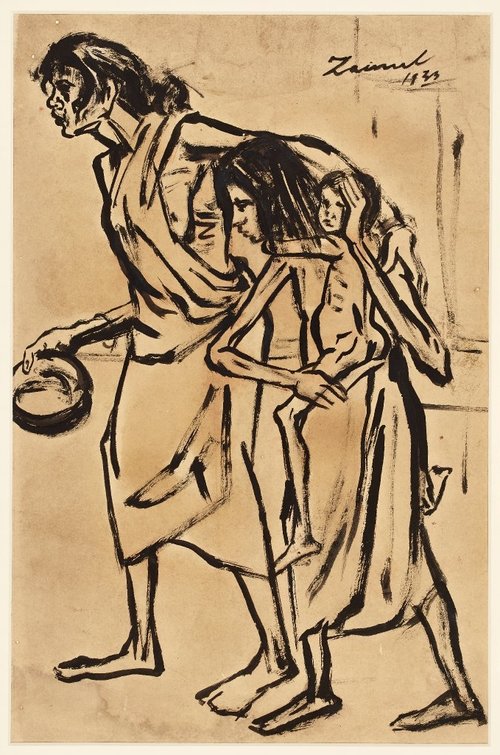
Widely recognized for his socio-political and realist works, Zainul Abedin’s drawings also reveal a sophisticated understanding of form. His sketches from the Famine Series demonstrate compositional balance, structural clarity, and the rhythmic use of line, showcasing a formalist approach even within a narrative context.
Kamrul Hassan
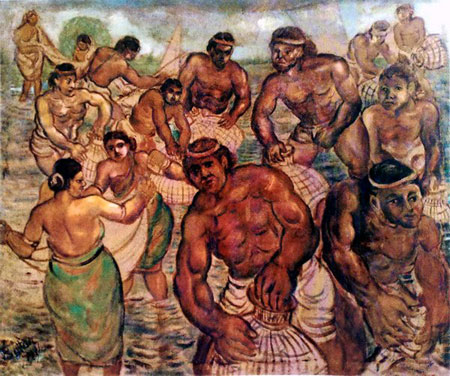
Kamrul Hassan merged folk aesthetics with formalist rigor, creating compositions that are visually balanced yet culturally resonant. His use of flat planes, strong outlines, and simplified forms reflects a conscious engagement with structural principles while preserving indigenous motifs.
Safiuddin Ahmed
Ahmed’s printmaking asizes texture, tonal contrast, and repetition. His lithographs and etchings reveal a focus on spatial organization and formal experimentation, underscoring the formalist tradition in mid-20th-century Bangladeshi art.
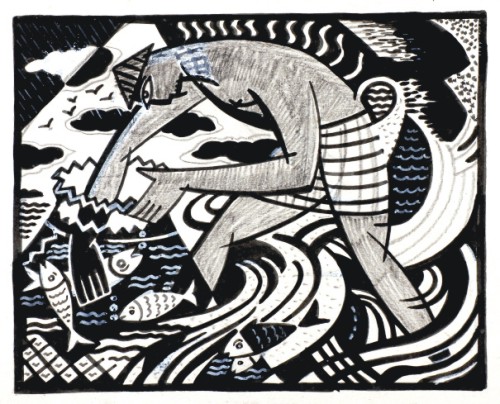
Mohammad Kibria
Kibria’s abstract paintings epitomize formalism in its purest sense. Layered surfaces, subtle color gradations, and balanced compositions shift the focus from narrative to visual experience. His work demonstrates that formalism can serve as a primary mode of expression in Bangladeshi abstraction.
Formalism in Contemporary Bangladeshi Art
Contemporary Bangladeshi artists keep expanding the principles of formalism through minimalist design, geometric abstraction, mixed media, and installation-based wor✓ he integration of conceptual ideas, techgical tools, and spatial manipulation reflects a dynamic interpretation of formalist theory. Artists such as Dilara Begum Jolly and Kaiser Kamal have explored installation and digital media, where spatial composition and viewer interaction become central, illustrating the evolving relevance of form in art beyond traditional painting.
This study employs visual analysis combined with historical and critical literature review. Each case study is examined for formal qualities-line, color, shape, composition, texture-while contextual factors such as historical period, cultural influence, and medium are considered. Comparative analysis with Western formalist principles allows for a nuanced understanding of how Bangladeshi artists localized formalist strategies.
While formalism offers rigorous tools for analyzing visual structure, critics argue that it can overlook socio-political and cultural context. In Bangladesh, where art is intertwined with history, politics, and identity, purely formalist readings may appear limited. This tension has led contemporary scholars to advocate for hybrid approaches that combine formal analysis with contextual interpretation, balancing aesthetic and cultural understanding.
Formalism has significantly shaped the development of Bangladeshi fine art, from early modernists to contemporary practitioners. By foregrounding structural and visual elements, it has provided a framework for innovation and experimentation while engaging with global modernist discourse. Contemporary adaptations show that formalism remains a flexible and relevant analytical and creative strategy. This study emphasizes that understanding formalism in Bangladesh requires attention to both visual form and cultural context, highlighting its enduring importance in academic research and artistic practice.
References
Bell, C. (1914). Art. London: Chatto & Windus.
Fry, R. (1920). Vision and Design. London: Chatto & Windus.
Haque, S. (1998). Bangladesh: Art and Architecture. Dhaka: University Press Limited.
Islam, S. (2011). Modern Art Movement in Bangladesh. Journal of Fine Arts, 5(1), 23-37.
Kibria, M. (2008). Paintings and Thoughts. Dhaka: Bengal Foundation.
Jolly, D. B. (2015). Installation Practices in Bangladesh: Spatial Formalism. South Asian Art
Review, 12(2), 45-63.
Kamal, K. (2013). Contemporary Abstraction in Bangladesh. Dhaka Art Journal, 8(1), 78-92.
Roy, B. L. (2026). Analyzing Form and Structure in Bangladeshi Art. Unpublished
manuscript.
Ahmed, S. (1995). Printmaking Techniques and Visual Form. Dhaka: Art Studies Press.
Hassan, K. (2000). Folk Aesthetics and Formalism. Bangla-1. Art Review, 3(1)