
written by: News Desk
Through embroidery, Nakshi Kantha, photography, video and sculpture, artist Sumana Akter questions gender-based oppression, social inequality, the violence of language and humanity’s domination over nature.
Social discrimination against women, derogatory language, control over the female body and human exploitation of nature are among the pressing concerns explored through the artistic practice of Sumana Akter. Her second solo visual art exhibition, Disordered Dialogues (Obinnyasto Songlapera), brings together personal experiences, memories and broader social realities to construct a distinctive artistic language.
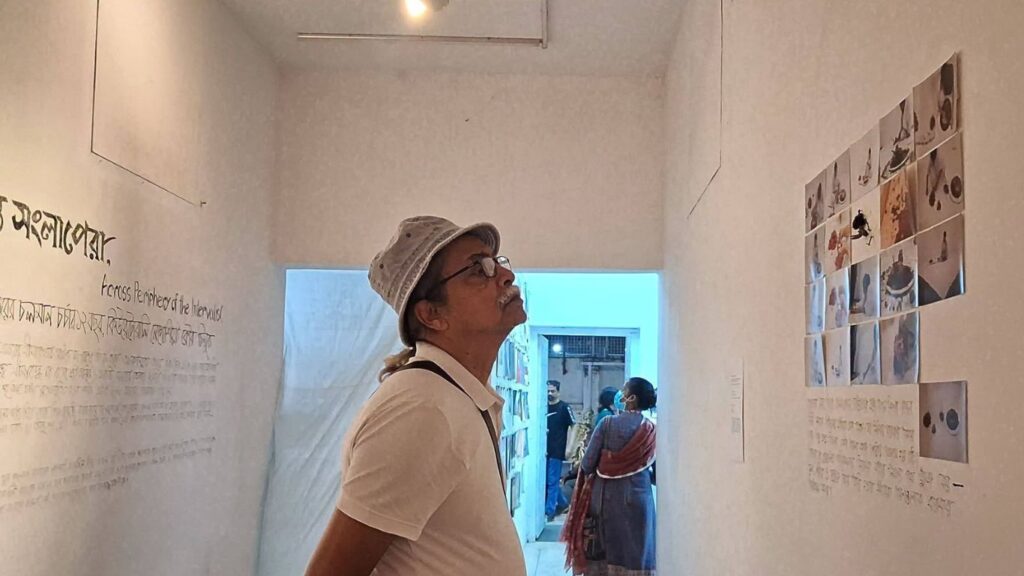
The exhibition opened on October 31 at Kalakendra in Lalmatia, Dhaka. Curated by Kaur Chimuk, it features selected works from the artist’s decade-long practice, alongside several projects developed over a period of more than five years. Paintings, photographs, embroidery, Nakshi Kantha, soft sculptures and video performances come together to present the diverse dimensions of her artistic exploration.
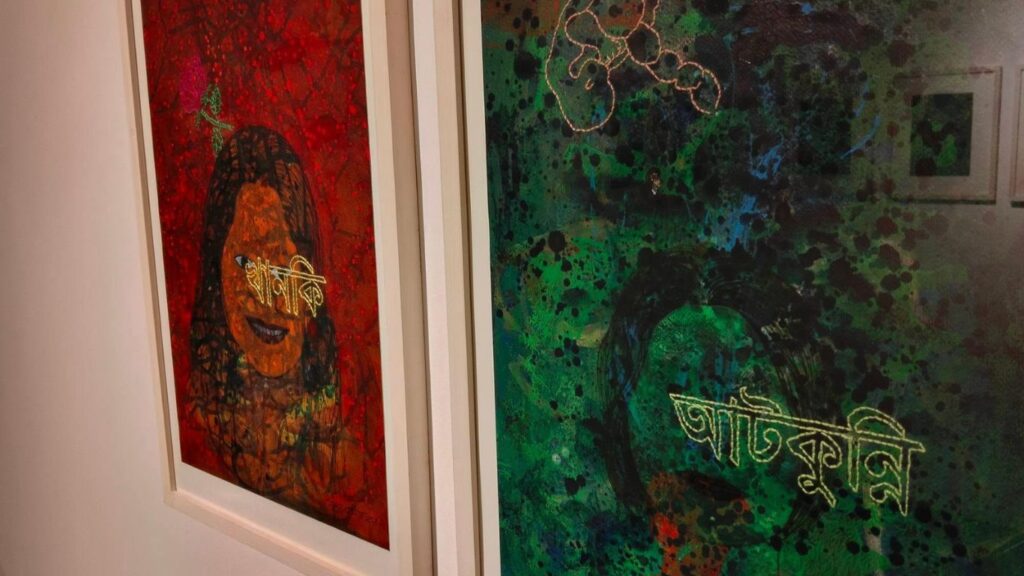
One of the notable bodies of work in the exhibition is the Gali (Abuse) series. Here, Sumana transforms derogatory words commonly used to demean and control women into artistic materials. Through canvas, fabric, thread, embroidery and soft sculpture, she makes these familiar expressions visible in an unfamiliar context. By drawing attention to their social implications, the artist raises a fundamental question: how does society assume the authority to define women’s identities, behaviour and freedom?
The use of embroidery carries particular significance in this context. Traditionally associated with domestic work and women’s labour, the medium becomes a language of resistance in Sumana’s practice. Words historically used to insult women are reproduced through needle and thread, transforming the language of humiliation into an artistic statement. The works also draw attention to the longstanding undervaluation of women’s labour and creativity.
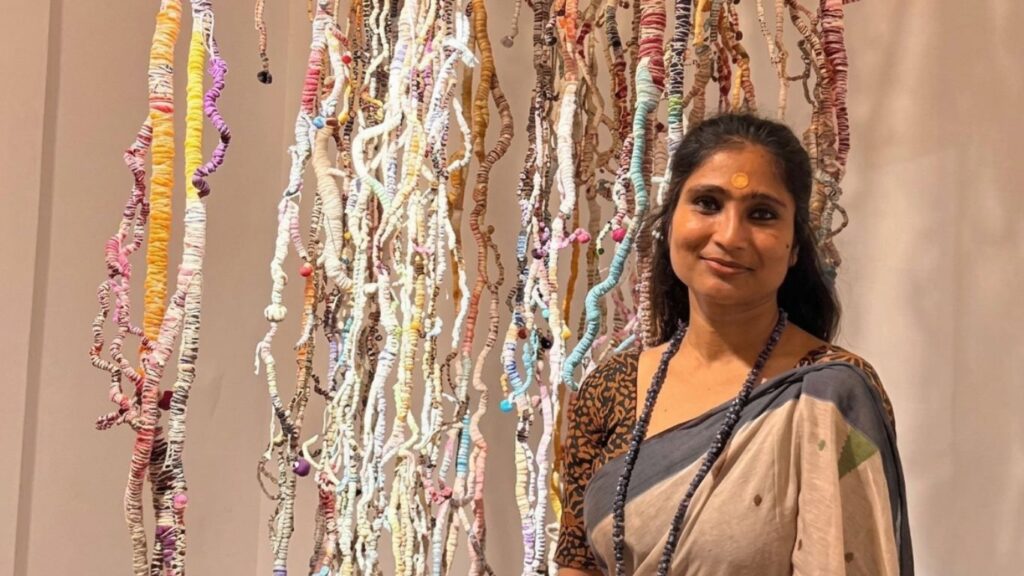
The series Five Minutes for the Sundarbans, which addresses environmental concerns, introduces another dimension of protest. Made from fabric, thread and memory-based materials, the suspended soft sculptures evoke the roots, rivers and natural landscape of the Sundarbans. The softness of the materials contrasts sharply with the harsh reality of environmental degradation. The work invites viewers to consider the shared logic of domination underlying both the control of women’s bodies and lives and humanity’s exploitation of nature.
Women’s identity and experiences of insecurity are central to another long-term project, Autobiography of a Rose. In the photographs and video works, the artist herself appears in different poses. In some images, she covers her face with her hands; in others, her eyes are closed, while in certain frames she holds a rose. Traditionally associated with love and beauty, the rose takes on a broader significance in this project, becoming a symbol of self-expression, resistance and the aspiration for freedom.
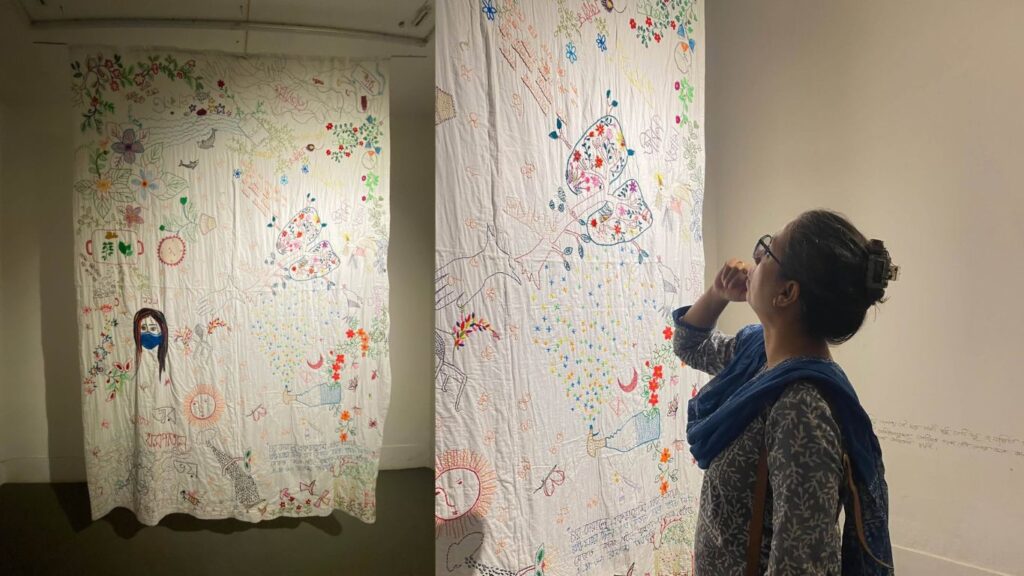
Another major work in the exhibition is an expansive Nakshi Kantha, developed over more than five years. It brings together traces of the artist’s everyday life, memories, conversations and struggles. Flowers, hands, faces, animals and Bengali texts form its intricate visual composition. A blue mask depicted on one of the faces recalls the confinement and social isolation experienced during the COVID-19 pandemic. Through the traditional practice of joining pieces of old fabric, the work brings personal memories into conversation with collective experiences.
Curator Kaur Chimuk has organised the exhibition into four sections: Autobiography of Fragmented Existence, Echoes, Intersections and Related Trajectories, and Melancholic Dialogues. Together, these sections explore personal memory, the body, identity, social relationships, language and environmental concerns. The curatorial approach suggests that solidarity does not necessarily depend on shared experiences or identical perspectives. Rather, it can emerge through the willingness to stand alongside one another while acknowledging differences. In this context, dialogue is not simply about reaching agreement, but about understanding experiences shaped by different positions and realities.
Bringing together works created between 2016 and 2026, the exhibition offers an opportunity to trace the evolution of Sumana’s artistic practice and the continuity of her concerns. While her choice of materials and modes of expression has evolved over time, she has consistently moved beyond the conventional boundaries of painting. By incorporating domestic materials such as fabric, thread and embroidery into contemporary visual art, she also challenges established distinctions between fine art and women’s household labour.
According to Sumana Akter, the exhibition brings together works developed across different periods and mediums during her approximately 12-year artistic journey. It is her second solo exhibition.
Disordered Dialogues will remain open to visitors at Kalakendra until November 21, from 4 pm to 8 pm daily.