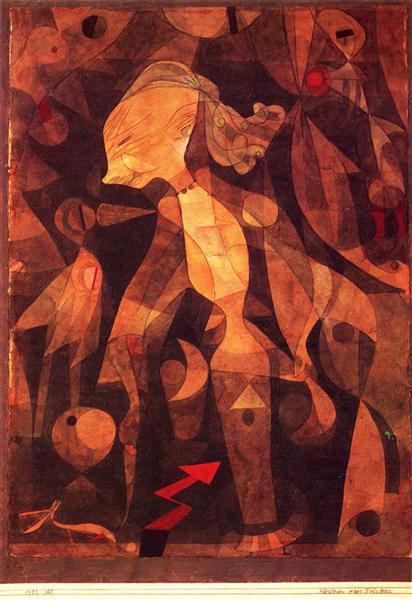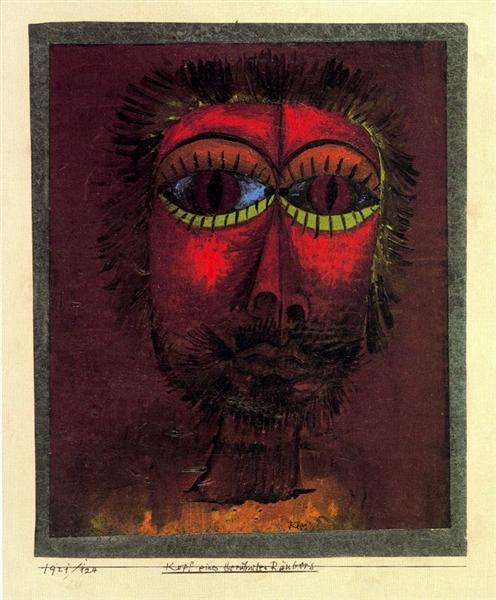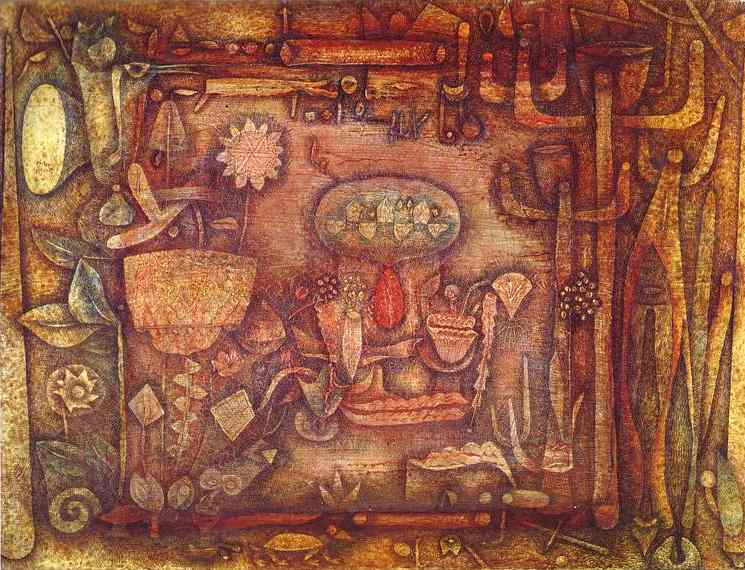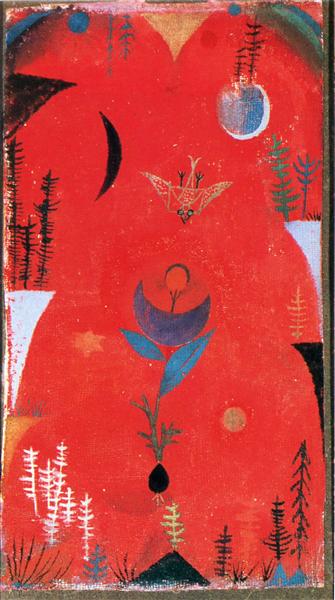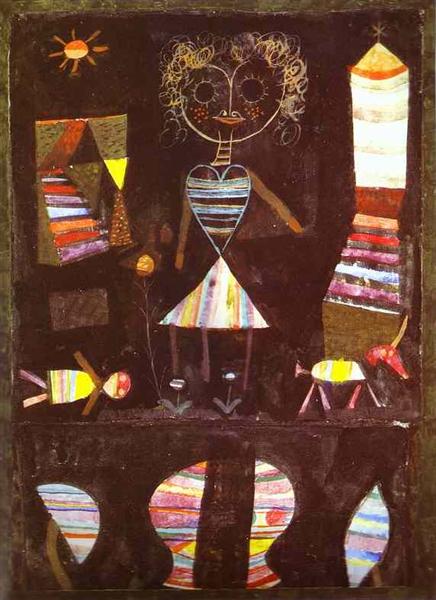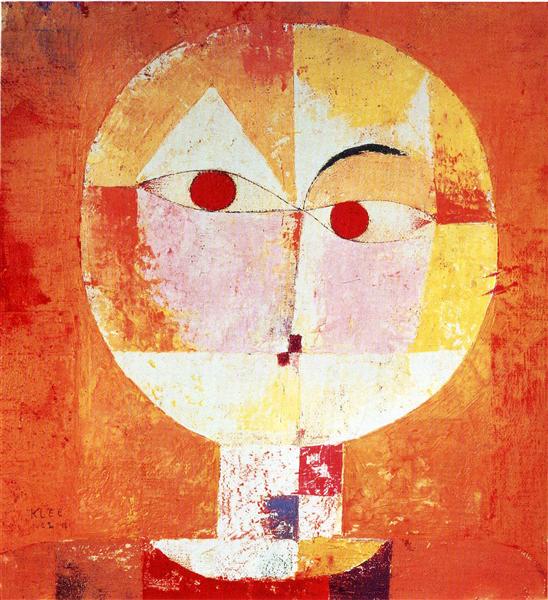

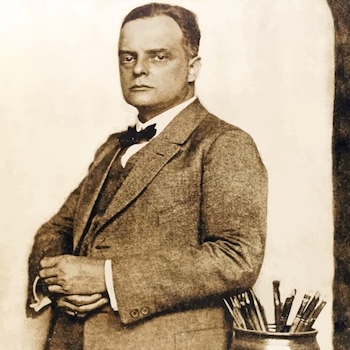
Paul Klee (1879–1940), the Swiss-born German painter, was a pioneering figure in modern art whose influence transcended genres, movements, and disciplines. As an artist, theorist, and teacher, Klee’s intellectual depth and emotional sensitivity found expression in a vast body of work that defies strict classification. Over his lifetime, he produced nearly 10,000 works— paintings, drawings, watercolors, and prints—each demonstrating his relentless experimentation with color, form, and line.
Klee’s approach was not only visual but philosophical. He famously said, “Art does not reproduce the visible; rather, it makes visible.” This guiding belief helped shape the abstract vocabulary of modern art in the 20th century and positioned Klee as one of its most poetic and imaginative voices.
Early Life and Education
Paul Klee was born on December 18, 1879, in Münchenbuchsee, near Bern, Switzerland. His father was a German music teacher, and his mother was Swiss. Klee showed early promise both in music and the visual arts. In fact, he was a gifted violinist and was encouraged by his parents to pursue a musical career. However, Klee eventually chose the visual arts, where he felt he could express more complex and ambiguous emotions.
In 1898, Klee moved to Munich to study at the Academy of Fine Arts, one of the most respected institutions in Europe at the time. There, he trained under Franz von Stuck, a leading Symbolist painter. While his classical training provided a solid foundation, Klee found academic realism limiting. He was more interested in the symbolic and abstract, drawn to the emotional depth of Expressionism and the visual freedom of the emerging avant-garde.
After graduation, Klee traveled extensively—particularly to Italy, where the works of Renaissance masters made a deep impression on him. Despite being technically proficient, he struggled to find a distinctive artistic voice during his early career, focusing instead on etchings and pen drawings that displayed his fine control and satirical wit.
Form and Medium
Paul Klee’s painting form was anything but conventional. He blurred the boundaries between drawing and painting, frequently combining media such as watercolor, oil, ink, pastel, and gouache. He often painted on unconventional supports—muslin, cardboard, burlap, or newspaper—giving his work a tactile, intimate quality.
Klee employed a rich variety of forms, ranging from abstract geometric patterns to whimsical figures, symbols, and dream-like landscapes. His compositions might include grids, spirals, arrows, and musical notations, all woven into a personal visual language. While some works are structured and architectural, others are fluid and spontaneous.
Throughout his career, Klee showed a unique ability to combine the rigor of formal structure with the spontaneity of imaginative play. His works often appear simple at first glance, but closer inspection reveals layers of meaning, allusion, and emotion.
Colour Theory and Technique
Klee’s use of color was revolutionary and central to his art. He studied color with the same seriousness he had once applied to music. He treated color as a living, breathing element— capable of conveying emotion, energy, and movement.
His breakthrough in color came after a 1914 trip to Tunisia with fellow artists August Macke and Louis Moilliet. In the brilliant Mediterranean light, Klee famously wrote in his diary, “Color has taken possession of me; no longer do I have to chase after it.” From that point forward, color became central to his work.
He used techniques like layering, glazing, and pointillism to create luminous effects. His color harmonies were subtle, often involving gradations and transitions that gave the work a musical rhythm. Many of his color studies were documented during his tenure at the Bauhaus, where he developed a pedagogical approach to color theory that continues to influence art education today.
Themes and Symbolism Klee’s works are dreamlike yet calculated, fantastical yet intellectual. He drew inspiration from a wide variety of sources:
- Nature and the Cosmos: Many of Klee’s works depict stylized plants, animals, and landscapes, reflecting his deep fascination with the organic world. Paintings like “Ad Parnassum” (1932) evoke natural order through symbolic geometry.
- Childhood and the Primitive: Klee admired the honesty and spontaneity in children’s drawings and tribal art. This influence is evident in his use of simplified forms, stick figures, and playful compositions.
- Music and Rhythm: His musical upbringing found expression in compositions that resemble musical scores. Works like “Fugue in Red” suggest harmonic relationships between line and color, akin to a musical fugue.
- Metaphysical and Spiritual: Klee was drawn to mysticism, philosophy, and the unseen aspects of life. His work often includes enigmatic symbols and otherworldly figures that suggest spiritual journeys and inner states of being.
- Politics and Society: Though rarely overtly political, Klee’s works during the 1930s subtly reflected the rising tensions in Europe. After being labeled a “degenerate artist” by the Nazi regime, his later works took on a darker tone, with somber colors and existential themes.
Teaching and the Bauhaus
In 1920, Klee was invited by architect Walter Gropius to join the Bauhaus, the pioneering school of modern art and design in Weimar, Germany. Klee became one of its most influential teachers, remaining there until the school’s closure in 1933.
At the Bauhaus, Klee taught workshops on color theory, form, and visual dynamics. His lectures were rigorous, incorporating mathematics, geometry, and philosophy. His pedagogical notebooks were later compiled into the book “Pedagogical Sketchbook” (1925), which remains a cornerstone of art education.
Klee’s teaching emphasized process over product. He believed that understanding the underlying structure of form and color was essential to creative expression. He influenced not only visual artists but also architects, designers, and musicians.
Awards and Recognition
While Klee did not receive traditional awards in the modern sense, his influence and recognition were significant during and after his life.
- Member of the Prussian Academy of Arts (appointed in 1931, but forced to resign under the Nazi regime in 1933).
- International Exhibitions: Klee’s work was exhibited widely in Europe and the United States during his lifetime. His first solo exhibition was held in 1910 in Switzerland, followed by major retrospectives in Munich, Paris, and Berlin.
- Posthumous Recognition: After his death, Klee’s legacy was celebrated in major museums around the world. The Zentrum Paul Klee in Bern, Switzerland, opened in 2005 and houses over 4,000 of his works.
The Nazi Era and Final Years
With the rise of Nazism, Klee became a target of the regime’s crackdown on modernist artists. In 1933, he was dismissed from his teaching post at the Düsseldorf Academy and labeled a ―degenerate artist‖ by the Nazis. His works were removed from German museums, and over a hundred were displayed in the infamous “Degenerate Art” exhibition (1937), intended to ridicule modern art.
Klee returned to Switzerland, where he continued to paint despite declining health. He was diagnosed with scleroderma, a degenerative disease, which severely limited his physical abilities. Nevertheless, he produced some of his most profound and emotionally resonant works during this period, often grappling with themes of mortality, resilience, and transcendence.
He died on June 29, 1940, in Locarno, Switzerland, leaving behind a legacy of creativity, inquiry, and boundless imagination.
Legacy
Paul Klee’s legacy is immense. He is considered a father of modern abstraction and a bridge between the Expressionist, Cubist, Surrealist, and Bauhaus movements. Artists such as Joan Miró, Wassily Kandinsky, Mark Rothko, and even contemporary figures like Anselm Kiefer and Cy Twombly have acknowledged his influence.
Klee’s work challenges viewers to see beyond the visible, to engage with the poetic and the metaphysical. His ability to fuse intellect with intuition, structure with spontaneity, and form with freedom remains unmatched in the history of art.
Paul Klee was more than a painter—he was a thinker, a teacher, and a visionary who redefined the boundaries of art. Through his unique synthesis of color, form, and symbolism, he created a body of work that continues to inspire, provoke, and enchant. His paintings invite us not merely to look but to listen, feel, and imagine. In Klee’s world, a line takes a walk, a color sings, and the soul finds its reflection in abstract form.
As the 20th century’s most lyrical modernist, Paul Klee left behind a timeless reminder: that art, at its best, is a journey into the unseen realms of thought, emotion, and spirit.
Watch our video of Paul Klee (Bangla): https://youtu.be/CXGZi6Ryp-0